Chronic pain doesn’t just hurt-it drains your energy, steals your sleep, and makes even simple movements feel like a battle. If you’ve tried pills, injections, or physical therapy and still feel stuck, you’re not alone. Millions of people are turning to something quieter, slower, and surprisingly powerful: yoga and tai chi. These aren’t just trendy workouts. They’re evidence-backed tools that help your body heal itself without drugs or surgery.
Why Yoga and Tai Chi Work for Pain
Most pain treatments focus on blocking signals-medications, nerve blocks, even surgery. But yoga and tai chi do something different. They retrain your nervous system. When you’re in chronic pain, your body stays on high alert. Muscles tighten. Breathing gets shallow. Stress hormones flood your system. Over time, this makes pain worse. Yoga and tai chi break that cycle. Both use slow, controlled movement paired with deep breathing and focused attention. This tells your brain: "You’re safe now." Studies show this reduces inflammation, lowers cortisol, and improves how your brain processes pain signals. A 2018 study in the New England Journal of Medicine found that people with fibromyalgia who did tai chi for 12 weeks had 27% less pain, better sleep, and fewer symptoms of depression than those who only stretched. Another review of 16 studies on knee osteoarthritis showed tai chi improved balance by 18-25% compared to no treatment. For lower back pain, yoga has been shown to be as effective as physical therapy in reducing disability and pain intensity. The secret? It’s not strength. It’s awareness.How Tai Chi Helps-Even If You Can’t Stand
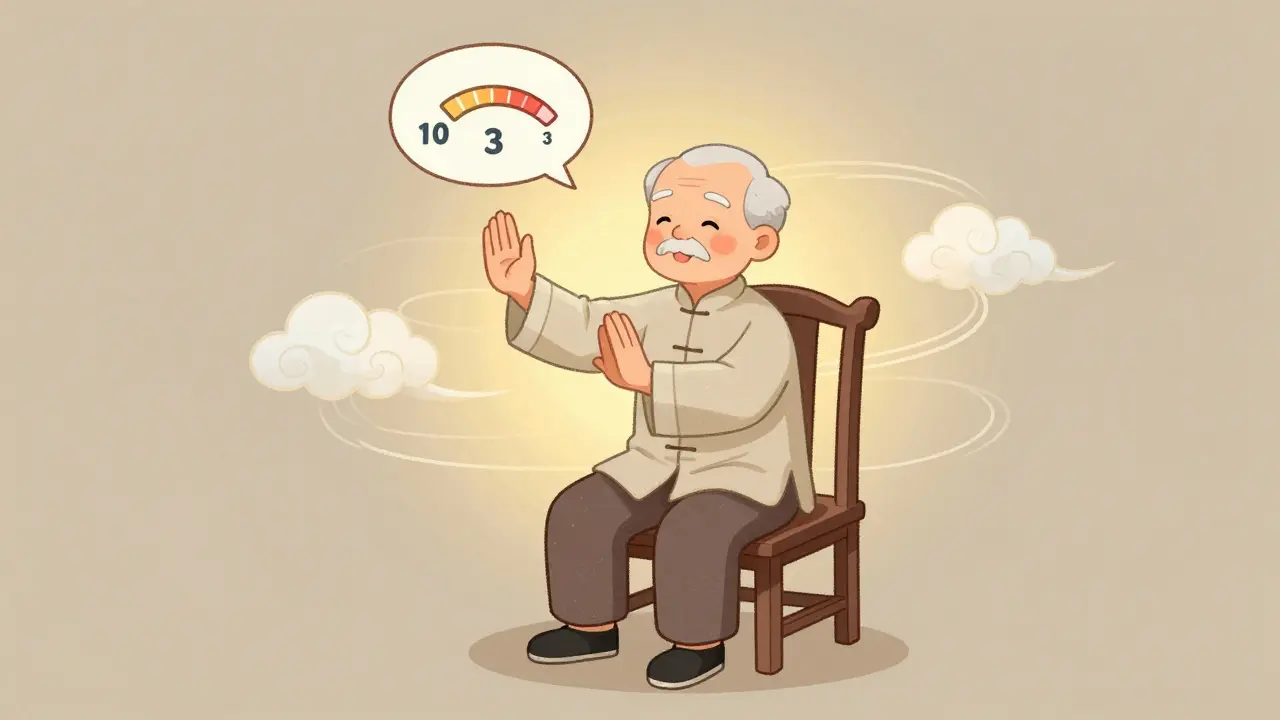
Tai chi looks like slow dancing. But it’s built on principles from martial arts designed to redirect force, not fight it. Each movement flows into the next: shifting weight from one foot to the other, turning the waist, raising the arms like clouds moving across the sky. This isn’t just graceful-it’s therapeutic. The constant, gentle motion improves circulation without jarring your joints. It strengthens the muscles around your knees, hips, and spine without putting pressure on them. And because you’re always grounded, your balance improves dramatically. That’s huge for older adults or anyone with joint pain who fears falling. You don’t need to stand for hours. Seated tai chi works just as well. One veteran with severe arthritis told me he started with a chair, doing just three moves a day. After six weeks, he could walk to the mailbox without painkillers. The VA now offers tai chi programs in 92 of its 170 medical centers, mostly because veterans report reduced opioid use after just six months.Yoga Isn’t Just Stretching
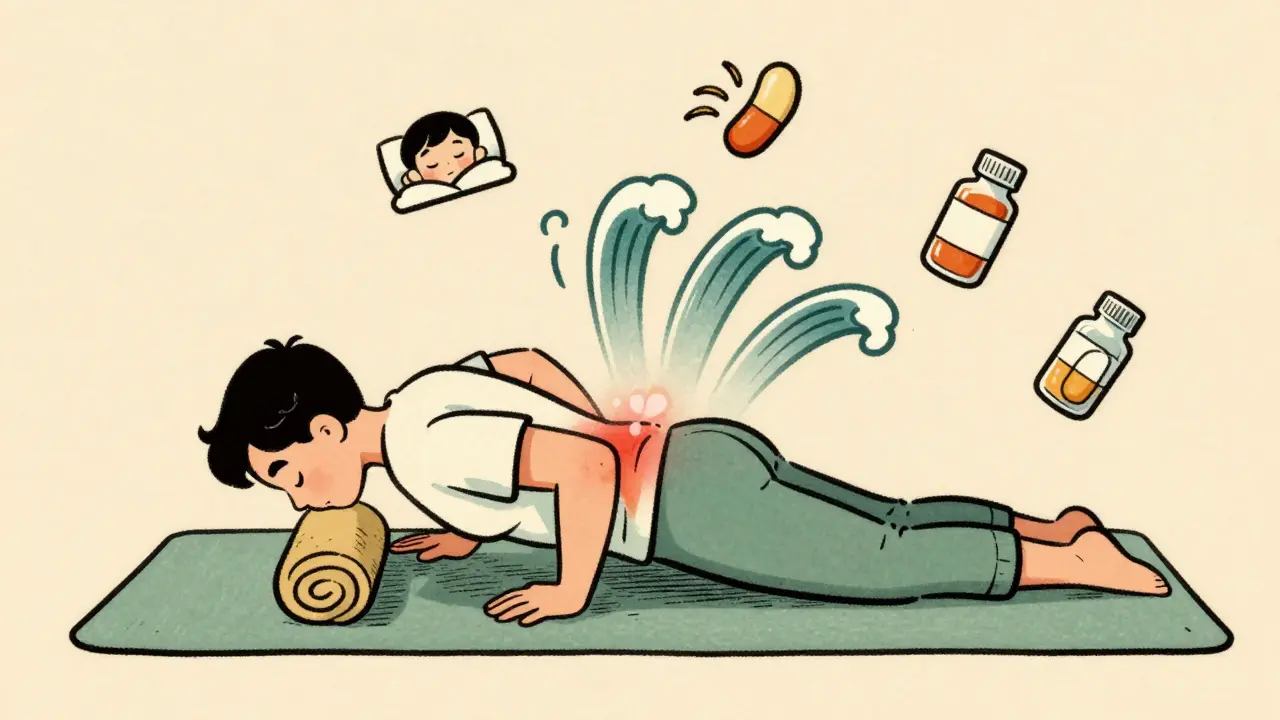
People think yoga means contorting into pretzel shapes. That’s not the kind used for pain relief. Hatha and Restorative yoga are the go-to styles. These focus on holding gentle poses for longer periods, using props like blocks, straps, and bolsters to support your body. One 2024 review found that yoga combined with hot sand fomentation (a traditional warmth therapy) reduced neck pain by 42% more than standard physical therapy. Why? Heat relaxes muscles. Yoga releases tension. Together, they give your nervous system a reset. For lower back pain, poses like cat-cow, child’s pose, and gentle spinal twists help restore natural movement. For arthritis in the hands, finger stretches and wrist circles improve mobility without strain. And because yoga encourages mindful breathing, it helps calm the anxiety that often comes with constant pain.What the Science Really Says
The evidence isn’t just anecdotal. Major institutions like the National Institutes of Health, Harvard Medical School, and the American College of Physicians all support these practices. The American College of Physicians recommends yoga and tai chi as first-line treatments for chronic low back pain-before medications. They rank them alongside cognitive behavioral therapy, ahead of acupuncture. Here’s what the data shows:- Tai chi: Most effective for fibromyalgia, knee osteoarthritis, and balance issues. Sessions of 60 minutes, 2-3 times a week for 12 weeks show the best results.
- Yoga: Strongest evidence for lower back pain, neck pain, and arthritis. Sessions of 60-90 minutes, 2-4 times a week for 8-12 weeks.
- Both: Reduce stress, improve sleep, and lower pain sensitivity over time.
Who Should Avoid These Practices?
These are gentle-but not risk-free. If you have severe spinal stenosis, recent fractures, or uncontrolled high blood pressure, you need to be careful. Some yoga poses can strain the neck or lower back if done wrong. A bad tai chi movement can throw off your balance. That’s why instruction matters. One Healthgrades review summed it up: "My first tai chi teacher didn’t know how to modify movements for knee osteoarthritis. It made my pain worse for two weeks." That’s why you want a teacher who understands chronic pain. Look for instructors certified by Yoga Alliance (200-hour minimum) or the National Certification Commission for Acupuncture and Oriental Medicine (NCCAOM) for tai chi. Ask if they’ve worked with people with your condition before.How to Start Without Spending a Fortune
You don’t need expensive gear or a gym membership.- Yoga: Get a nonslip mat (under $20). Use pillows or towels as props. Try free YouTube channels like "Yoga for Chronic Pain" by Yoga Medicine or "Gentle Yoga for Beginners" by Yoga with Adriene.
- Tai Chi: Download the free "Tai Chi for Arthritis" app from the Arthritis Foundation. It’s designed by Dr. Paul Lam, a leading expert in medical tai chi. Start with 10 minutes a day.
Real People, Real Results
On Reddit’s r/ChronicPain, 78% of users who tried tai chi reported moderate to significant pain reduction. One woman with rheumatoid arthritis said: "I can do seated tai chi on high-pain days when yoga isn’t possible. It’s the only thing that doesn’t make me feel broken." Men often prefer tai chi because it feels more like movement than "yoga." One 28-year-old with lower back pain said: "I tried yoga. Felt too spiritual. Tai chi felt like I was learning something useful-like martial arts for my body." A veteran from the VA program shared: "I used to take two oxycodone pills just to get out of bed. After six months of tai chi, I’m down to zero. I sleep through the night. I walk my dog again."
What to Expect in the First Few Weeks
Week 1-2: You might feel stiff. Some discomfort is normal-your body is waking up. Don’t push through sharp pain. Modify. Sit. Use a chair. Week 3-4: You’ll notice small shifts. Maybe you sleep better. Maybe you don’t tense your shoulders as much when you’re stressed. Week 6-8: Pain starts to feel less constant. You might find yourself moving more freely without thinking about it. Week 12: This is where most people see real change. Less reliance on meds. More energy. Better mood. More confidence in your body.Don’t Replace-Combine
Yoga and tai chi aren’t magic cures. They’re tools. The American Chronic Pain Association found that combining them with conventional care-like physical therapy or medication-leads to 30-40% better outcomes than either alone. Think of them as part of your pain toolkit. Take your meds if you need them. Do your PT exercises. And add 20 minutes of yoga or tai chi each day. Your nervous system will thank you.What’s Next for These Practices?
In January 2025, doctors in the U.S. will be able to bill insurance for referring patients to yoga and tai chi. That’s huge. It means these aren’t fringe therapies anymore-they’re becoming part of mainstream care. The VA is testing virtual reality tai chi with motion sensors that give real-time feedback on posture. Early results show 28% better adherence. In the UK, NHS trials are expanding access in rural areas. The message is clear: movement, even gentle movement, is medicine. And it’s available to anyone willing to try.Can yoga or tai chi make my pain worse?
Yes, if done incorrectly or pushed too hard. Sharp pain, numbness, or increased swelling means stop. Always start with a qualified instructor who understands your condition. Chair-based versions are safer for beginners or those with severe mobility limits.
How long until I feel better?
Most people notice small improvements in sleep or stress after 2-4 weeks. Noticeable pain reduction usually happens between 6 and 8 weeks. Maximum benefits show up after 12 weeks of consistent practice-about three times a week.
Which is better for pain: yoga or tai chi?
It depends on your condition. Tai chi is especially strong for balance issues, fibromyalgia, and knee osteoarthritis. Yoga shows better results for lower back pain, neck pain, and arthritis in the hands. Both help with stress and sleep. Try both for a few weeks and see what feels right for your body.
Do I need special equipment?
No. A nonslip mat helps for yoga, but you can do it on a carpet. For tai chi, wear comfortable clothes and flat shoes-or go barefoot. Props like pillows, towels, or chairs are all you need to modify poses safely.
Can I do this if I’m older or have limited mobility?
Absolutely. Both practices can be done seated or with support. Many tai chi classes are designed for seniors. Chair yoga is widely available and proven effective for chronic pain. The key is modifying movements to fit your body-not forcing your body to fit the movement.
Is there insurance coverage for these classes?
In the UK, some NHS programs cover them if referred by a GP. In the U.S., Blue Cross Blue Shield covers them in 12 states. Starting in January 2025, U.S. doctors will be able to bill insurance for referrals. Check with your provider or local community center-many offer low-cost or sliding-scale options.




Jillian Angus
December 23, 2025 AT 13:37Been doing seated tai chi for 6 months since my knee surgery. No more painkillers at night. Just 10 minutes before bed. My dog even sits next to me now like we’re in some weird zen club.
Paula Villete
December 23, 2025 AT 13:53So let me get this straight-after 20 years of Big Pharma selling us opioids like candy, we’re finally gonna pay doctors to prescribe… yoga? And it took a federal policy change for this to happen? Of course. The system only works when it’s profitable. But hey, at least the truth’s out now. Also, typo: ‘fomentation’ is not a word I thought I’d see outside a 19th-century medical journal. 😏
suhani mathur
December 25, 2025 AT 11:31Yoga with Adriene is my therapist. She says ‘breathe’ like she’s whispering secrets to a lost puppy. I cry in child’s pose. Not because I’m sad-because my hips finally remember how to relax. Also, chair yoga is the unsung hero of chronic pain. No one talks about it enough.
John Pearce CP
December 26, 2025 AT 07:13Western medicine is collapsing under its own weight. This is what happens when you replace discipline with convenience. Yoga and tai chi aren’t ‘alternative’-they’re ancient. The fact that we need a government mandate to return to basic human movement says everything about how broken we’ve become.
Bhargav Patel
December 28, 2025 AT 03:00One must consider the epistemological foundations of pain perception. The Cartesian dualism of body and mind has long been debunked, yet our medical infrastructure persists in treating pain as a purely physiological phenomenon. Yoga and tai chi, by integrating somatic awareness with breath regulation, restore the phenomenological unity of the embodied self. The empirical data corroborates this, yet institutional inertia remains formidable. One wonders whether the resistance stems from economic interests or from a deeper cultural aversion to non-instrumental forms of healing.
Adarsh Dubey
December 28, 2025 AT 09:23I tried yoga after my herniated disc. First class, I couldn’t touch my knees. Second class, I could reach my shins. By week 6, I was walking without wincing. No magic. Just consistency. And props. Lots of props. A rolled-up towel saved my spine.
EMMANUEL EMEKAOGBOR
December 28, 2025 AT 10:42As a Nigerian who grew up with traditional healing practices, I find it ironic that Western medicine is now ‘discovering’ what our grandmothers knew: stillness is medicine. In my village, we used slow movement and breath to calm the body long before anyone had a MRI. This is not new. It’s just being repackaged with a TED Talk.
Lu Jelonek
December 29, 2025 AT 18:30For those in rural areas with no access to classes: the Arthritis Foundation’s app is gold. I taught my 78-year-old mom using it. She does it in her kitchen while waiting for the kettle. No mat. No fancy clothes. Just slow movement. She says it’s the first time in 10 years she’s felt ‘light’ in her joints.
Rachel Cericola
December 31, 2025 AT 14:59Let’s be real-this isn’t about yoga or tai chi being ‘better.’ It’s about reclaiming agency. When you’ve been told your pain is ‘all in your head’ for years, and then you find a practice that makes your body feel like it belongs to you again? That’s not therapy. That’s liberation. And yes, it takes time. But if you’ve spent years begging for a pill to fix you, why not try a practice that helps you fix yourself? I didn’t heal because I did downward dog-I healed because I finally stopped fighting my body.
And to the people saying ‘it’s just stretching’-you’ve never had a flare-up so bad you couldn’t roll out of bed. Come back when your spine feels like shattered glass and tell me stretching is ‘just’ anything.
Harsh Khandelwal
January 1, 2026 AT 23:04Yoga is a cult. Tai chi is the government’s way of keeping us docile. They don’t want us strong-they want us ‘calm.’ You think they’d let a billion-dollar pharma industry collapse unless they controlled the alternative? The VA program? Yeah right. They’re just swapping one dependency for another. Next thing you know, your meds will be replaced with a QR code to a YouTube video. Wake up.
siddharth tiwari
January 2, 2026 AT 22:11you know what else reduces pain? not getting ripped off by insurance companies. why is it that when you pay for physio you get 30 mins of someone yelling at you to ‘push harder’ but when you do yoga you get ‘gentle breath’ and free vibes? this is capitalism. they sell pain relief as a product. but real healing is free. and they hate that.
Diana Alime
January 3, 2026 AT 09:49I did yoga for 3 weeks. I cried once. I screamed once. I thought I was dying. My back didn’t improve. I still need my meds. I’m not saying it doesn’t work-I’m saying maybe it’s just not for everyone. And if you’re gonna sell this as ‘medicine,’ at least admit it’s not a cure. It’s a coping mechanism. And that’s fine. But don’t make me feel guilty for still needing ibuprofen.
Christine Détraz
January 5, 2026 AT 02:40I started with tai chi after my husband passed. I didn’t do it for the pain. I did it because I didn’t want to be alone in my body anymore. The movements felt like talking to him. Slow. Gentle. Like he was still holding my hand. After 4 months, I noticed I wasn’t tensing up every time I heard a car backfire. I didn’t know grief lived in my hips until I started moving. This isn’t just pain relief. It’s soul repair.
Paula Villete
January 6, 2026 AT 15:54Wait, so the VA is using VR tai chi now? That’s either genius or the most dystopian thing I’ve heard since ‘smart’ toothbrushes. Next they’ll be tracking your ‘mindfulness score’ via Apple Watch. ‘You only achieved 67% zen today. Please meditate for 12 more minutes to unlock your pain relief tier.’