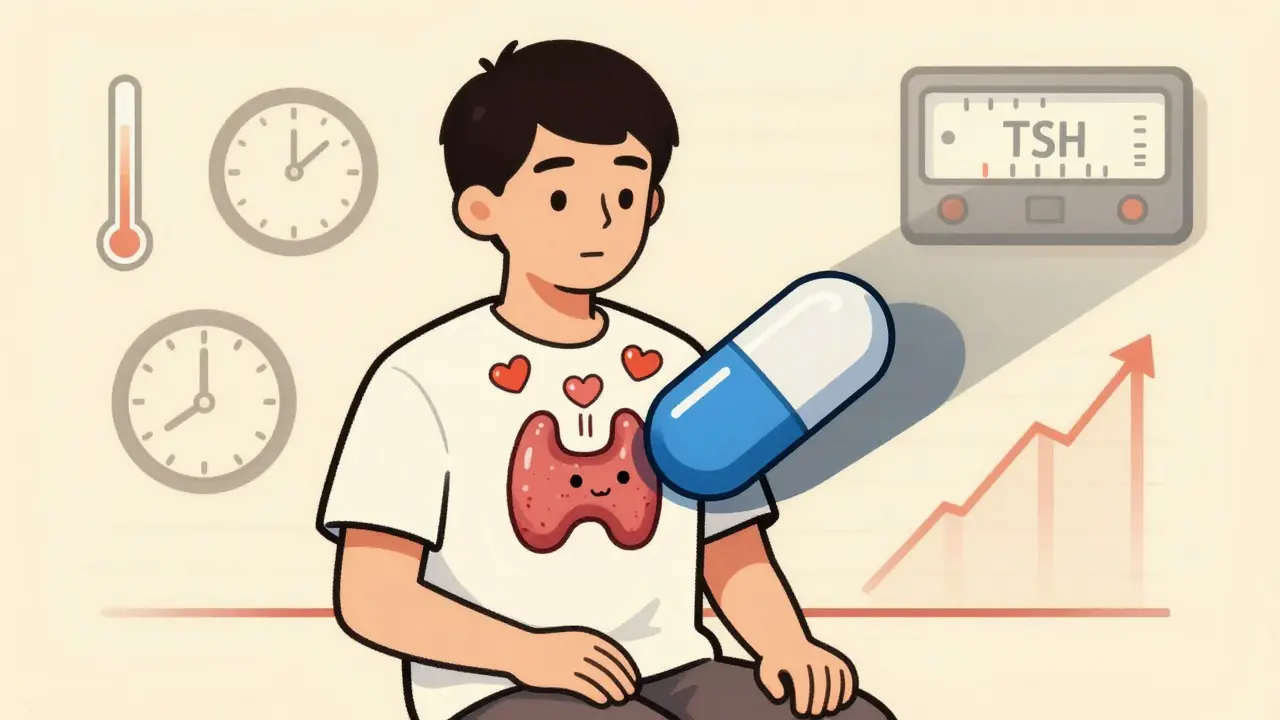
Thyroid Monitoring Schedule Generator
Why Monitoring Matters
Lithium users have up to 32% risk of thyroid dysfunction. Early detection prevents complications. The American Thyroid Association recommends testing before starting lithium and regularly thereafter. Your schedule depends on dose, gender, and treatment duration.
Your Details
Key Risk Factors
Your Personalized Monitoring Schedule
When you're managing bipolar disorder, lithium can be a lifeline. It’s one of the oldest and most effective mood stabilizers we have, proven to cut the risk of manic and depressive episodes by nearly 40%. But for many people, that benefit comes with a hidden cost: your thyroid. About 1 in 5 people on long-term lithium develop hypothyroidism. Some get goiters. A few even face sudden thyroid swings after stopping the drug. If you’re on lithium, you need to know how it affects your thyroid - and what to do next.
How Lithium Messes With Your Thyroid
Lithium doesn’t just calm your mood. It also interferes with how your thyroid works. Your thyroid makes hormones that control energy, weight, temperature, and even your heartbeat. Lithium blocks key steps in that process. It stops your thyroid from making enough hormone, prevents it from releasing what it does make, and even changes how your body converts one hormone into another. The result? Your body starts acting like it’s running on low fuel.One major mechanism is how lithium disrupts thyroglobulin - the protein your thyroid uses to build hormones. It also increases iodine buildup inside the gland, which sounds harmless but actually makes things worse over time. And it doesn’t stop there. Lithium changes the structure of thyroid cells, causing them to multiply abnormally. That’s why up to 60% of people on lithium develop goiters - swollen necks caused by an enlarged thyroid.
What’s surprising is that this isn’t just about dose. A 2024 study found that every 100 mg increase in daily lithium dose raises your odds of thyroid problems by 27%. But here’s the twist: the longer you’re on lithium, the less dramatic the effect becomes. Your thyroid may slowly adapt. Still, that doesn’t mean you’re safe. Monitoring is non-negotiable.
The Numbers Don’t Lie: Who Gets Affected?
If you’re a woman under 60, your risk is higher. Studies show women develop lithium-induced hypothyroidism more than three times as often as men on the same dose. Age matters too - the longer you’ve been on lithium, the more likely you are to see changes. After 10 years, about half of patients have visible thyroid enlargement. In places like Denmark, where iodine intake is lower, goiter rates hit 50%. In the U.S., where iodized salt is common, it’s closer to 30%. That tells you environment plays a role.And the stats on hypothyroidism? They’re stark. One 2023 study of over 1,200 patients found 32% developed thyroid dysfunction - and 79% of those were hypothyroid. That means nearly 1 in 3 people on lithium need thyroid hormone replacement. On Reddit, 68% of users who shared their experience reported thyroid issues, with 82% of them diagnosed with hypothyroidism. One person wrote: “My TSH jumped from 1.8 to 8.7 in 18 months. I’m on levothyroxine now, but my psychiatrist won’t lower my lithium dose.” That’s the hard trade-off many face: stable mood versus constant fatigue.
Hypothyroidism vs. Hyperthyroidism: What’s the Difference?
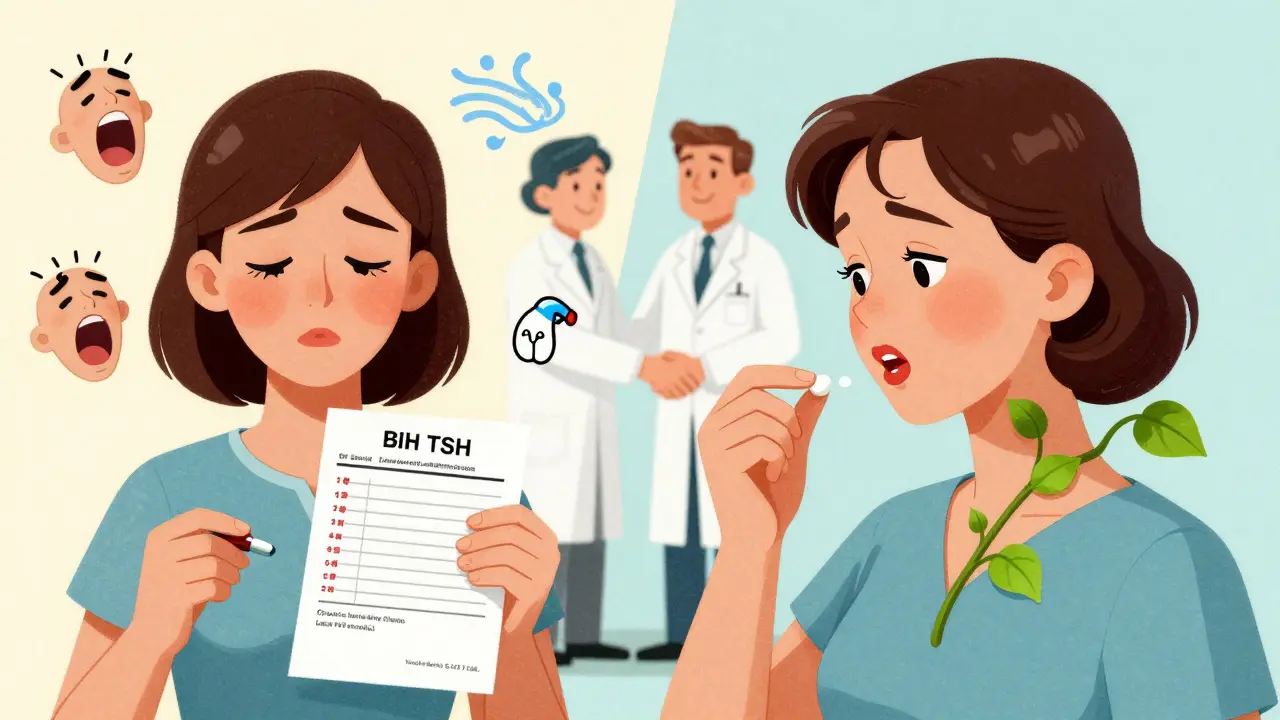
Most people on lithium develop hypothyroidism. Symptoms include fatigue, weight gain, cold intolerance, dry skin, brain fog, and depression - which can easily be mistaken for worsening bipolar symptoms. That’s why doctors need to test thyroid levels before starting lithium and then every 6 months. If your TSH rises above 4.5 mIU/L, it’s time to consider levothyroxine.Hyperthyroidism is rarer - only 3-5% of lithium users. But when it happens, it’s usually not Graves’ disease. It’s painless thyroiditis: your thyroid gets inflamed, leaks stored hormone, and then burns out. You might feel anxious, sweaty, or have a racing heart - but no eye swelling or tremors. The good news? It often resolves on its own within 3-6 months. The bad news? You can’t treat it with anti-thyroid drugs like methimazole. Those won’t help because your thyroid isn’t overproducing - it’s leaking.
Here’s the catch: stopping lithium suddenly can trigger a thyroid storm - a life-threatening surge of thyroid hormone. One documented case involved a patient who had hemodialysis for lithium toxicity, and within days, went into thyroid storm. So never quit lithium without medical supervision.
What Should You Do? Monitoring and Management
The American Thyroid Association says: test before you start. Get your TSH and free T4 checked before your first lithium dose. Then, every 6 months for the first year. After that, once a year - unless your levels change. If TSH creeps up above 4.5, start levothyroxine. Don’t wait for symptoms. Many people feel fine until their TSH hits 10 or higher.Levothyroxine dosing is trickier than usual. People on lithium often need 20-30% more hormone replacement than those not on lithium. Why? Because lithium blocks how well your body uses the medication. Start low - 25 to 50 mcg - and retest in 6 weeks. Adjust slowly. And remember: it takes 6-8 weeks for TSH to reflect changes after starting or changing lithium. So don’t panic if your TSH is slightly high in month two. Wait. Re-test.
Primary care doctors often get this wrong. A 2022 study found 23% of them stopped lithium because of a mildly elevated TSH in the first three months. That’s dangerous. You’re trading a proven mood stabilizer for a temporary lab glitch. Always consult a psychiatrist and endocrinologist together before making changes.
What About Other Mood Stabilizers?
If you’re worried about thyroid issues, you might wonder: should I switch? Valproate can cause mild TSH elevations in 5-10% of users. Carbamazepine? Almost no thyroid effect. But here’s the reality: none of them match lithium’s power in preventing suicide. A 2013 BMJ study showed lithium reduces suicide attempts by 14% more than other mood stabilizers. That’s not just a statistic - it’s life-saving.And while newer drugs like lamotrigine or quetiapine are popular, they don’t have the same track record for long-term stability. Many patients on lithium say: “I have fatigue and weight gain, but I haven’t had a manic episode in 8 years.” That’s the trade-off. For many, the thyroid issues are manageable. The mood swings aren’t.
New Hope: Selenium and Future Drugs
There’s good news on the horizon. A 2023 clinical trial gave 100 mcg of selenium daily to lithium users. After two years, hypothyroidism dropped from 24% to 14%. Selenium helps your thyroid handle oxidative stress and may reduce antibody activity. It’s not a cure, but it’s a simple, safe addition. Ask your doctor if it’s right for you.Looking ahead, researchers are developing lithium-like drugs that don’t hurt the thyroid. RG101, currently in Phase II trials, shows similar mood-stabilizing effects but doesn’t raise TSH levels. If it works, it could replace lithium for many. But it’s still years away.
What If You Want to Stop Lithium?
Some people ask: can I stop lithium if my thyroid is messed up? The answer isn’t simple. Hypothyroidism often reverses after stopping lithium - but not always. And as mentioned, stopping suddenly can trigger hyperthyroidism or worse. If you’re considering stopping, work with your team. Slow tapering. Close monitoring. Thyroid tests every 2-4 weeks. And don’t assume your mood will stay stable. Many people relapse within months.Bottom Line: Don’t Panic. Stay Informed.
Lithium isn’t perfect. But for millions, it’s the difference between chaos and control. Thyroid problems are common, predictable, and manageable. You don’t need to quit lithium because your TSH went up. You need to treat it - with levothyroxine, selenium, and regular checkups. Keep testing. Keep talking. And remember: your thyroid issue doesn’t mean your treatment failed. It just means you’re doing it right - by staying aware.Does lithium always cause thyroid problems?
No. Not everyone on lithium develops thyroid issues. About 20-32% of long-term users do - mostly hypothyroidism. Some never have problems. Risk depends on dose, gender, age, iodine intake, and genetics. Regular monitoring catches issues early, so you can treat them before they affect your health.
Can I take levothyroxine with lithium?
Yes, absolutely. Levothyroxine is the standard treatment for lithium-induced hypothyroidism. You’ll likely need a higher dose than someone not on lithium because lithium reduces how well your body uses thyroid hormone. Take levothyroxine on an empty stomach, at least 4 hours apart from lithium, to avoid absorption issues.
How often should I get my thyroid tested on lithium?
Test before starting lithium, then every 6 months for the first year. After that, once a year if your levels are stable. If your TSH starts rising or you develop symptoms like fatigue or weight gain, test every 3 months until stabilized. Don’t skip tests - even if you feel fine.
Can selenium help prevent lithium-induced thyroid damage?
Yes. A 2023 study showed that taking 100 mcg of selenium daily cut the rate of hypothyroidism in half over two years. Selenium supports thyroid antioxidant function and may reduce inflammation. It’s safe, inexpensive, and worth discussing with your doctor - especially if you’re on long-term lithium.
Should I stop lithium if my thyroid gets worse?
Rarely. Most thyroid issues can be managed with medication. Stopping lithium often leads to mood relapse - and in some cases, triggers dangerous thyroid storms. Only consider stopping if your mood is stable without it, or if thyroid damage is severe and unmanageable. Always taper slowly under medical supervision.
Janelle Pearl
March 10, 2026 AT 06:56When I first started lithium, my doctor said my thyroid would be fine. I believed her. Then, after 18 months, I was exhausted all the time, gaining weight, and crying for no reason. My TSH was 9.2. I thought it was just my bipolar acting up again. Turns out, it was my thyroid screaming for help.
Levothyroxine changed everything. Not magic, but close. I still get tired sometimes, but I can function. I don’t cry over spilled coffee anymore. And yes, I take it 4 hours apart from lithium. No shortcuts.
Don’t wait until you’re in crisis to test. Six months? Do it. Your brain deserves better than guesswork.
Peter Kovac
March 10, 2026 AT 12:13The data presented in this article is statistically sound but lacks critical context regarding confounding variables. For instance, the correlation between lithium dosage and thyroid dysfunction does not account for baseline TSH levels, genetic polymorphisms in deiodinase enzymes, or dietary iodine intake variability across populations.
Moreover, the claim that selenium supplementation reduces hypothyroidism incidence by 50% is derived from a single-center, non-blinded trial with a sample size of 87. Replication studies are lacking. The American Thyroid Association guidelines do not endorse selenium as standard of care.
While clinical anecdotes are compelling, evidence-based medicine requires rigorous meta-analyses, not Reddit polls.
APRIL HARRINGTON
March 11, 2026 AT 21:35I’M SO DONE WITH THIS
I’VE BEEN ON LITHIUM FOR 12 YEARS
MY THYROID IS A MESS
I’M ON 125 MCG OF LEVO
AND STILL I’M COLD ALL THE TIME
MY DOCTOR SAYS JUST LIVE WITH IT
NO I WON’T
I’M TAKING SELENIUM NOW AND I’M TELLING EVERYONE
IF YOU’RE ON LITHIUM AND NOT TESTING YOUR TSH EVERY 6 MONTHS YOU’RE PLAYING RUSSIAN ROULETTE WITH YOUR ENERGY
MY FRIEND DIED FROM A THYROID STORM BECAUSE SHE STOPPED LITHIUM WITHOUT MONITORING
WE NEED TO TALK ABOUT THIS
WE NEED TO SCREAM ABOUT THIS
Leon Hallal
March 12, 2026 AT 22:01They say lithium helps with mood. But what about the weight? The fatigue? The brain fog? You think you’re getting better but you’re just slower. I used to run marathons. Now I can’t walk to the mailbox without needing a nap. My thyroid’s shot. And my doctor won’t listen. I’m not quitting. But I’m not happy either.
Judith Manzano
March 14, 2026 AT 17:06I’ve been on lithium for 8 years and my TSH has hovered around 4.0. I started selenium at 100 mcg last year. My energy improved, my hair stopped falling out, and I stopped needing 3 naps a day. I didn’t even realize how bad it was until it got better.
It’s not a cure, but it’s a shield. And if you’re on lithium long-term, you deserve that shield. Talk to your endo. Ask about selenium. It’s cheap. It’s safe. And it might save you from years of feeling like a ghost.
rafeq khlo
March 15, 2026 AT 18:30It is a well-established fact that psychiatric medications are inherently toxic and should be avoided at all costs. The thyroid damage caused by lithium is merely a symptom of a deeper systemic failure in modern psychiatry. Patients are being chemically enslaved under the guise of treatment.
The suggestion of levothyroxine supplementation is a dangerous illusion. It perpetuates dependency. True healing comes from lifestyle, spiritual discipline, and rejection of pharmaceutical control. This article is a propaganda tool for Big Pharma.
Stop taking lithium. Stop taking levo. Go organic. Walk barefoot. Meditate. Your body will heal itself if you stop poisoning it.
Stephen Rudd
March 15, 2026 AT 18:58So let me get this straight - you’re telling me we should just accept that lithium ruins your thyroid and then throw a pill at it? That’s not management, that’s damage control.
And you’re recommending selenium? Like a bandaid on a gunshot wound? What about the fact that lithium’s suicide prevention stats are based on 1970s data? We have better options now. Lamotrigine, ketamine, even TMS - all without the thyroid carnage.
This isn’t ‘staying informed.’ This is surrendering to outdated medicine. If your thyroid is failing, maybe your brain is screaming for a different path. Stop glorifying sacrifice. Start demanding better.
Dan Mayer
March 17, 2026 AT 12:34you know what i dont get is why people think they can just take levo and be fine? its not like its a magic bullet. i took 100mcg for 6 months and still felt like a zombie. and the lithium? it kept my moods stable but i gained 40lbs and my hair fell out. i think we need to stop pretending this is a win. its just a trade you make because you dont have a choice. and dont even get me started on the fact that doctors dont even know how to dose levo right for lithium users. its a mess.
Ray Foret Jr.
March 19, 2026 AT 06:20My TSH hit 12. I was so tired I couldn’t hold my coffee cup. My therapist said, ‘It’s probably just your bipolar.’ I said, ‘No, it’s my thyroid.’ I begged for a test. They finally did. Levo started me at 50 mcg. Took 3 months to feel human again.
Now I take selenium too. And I don’t skip my labs. I’m not ‘cured.’ But I’m not dead inside anymore.
If you’re on lithium - don’t wait to feel bad. Test now. Talk now. You’re worth more than a lab number.
Samantha Fierro
March 21, 2026 AT 03:47Thank you for writing this with such clarity. As a mental health nurse, I see too many patients who are told, ‘It’s just your illness,’ when it’s actually their thyroid.
The most heartbreaking part? They’re often dismissed because their mood is ‘stable.’ But stability shouldn’t come at the cost of daily function. You can’t live a full life if you’re cold, exhausted, and foggy.
Test early. Test often. Treat early. Levothyroxine isn’t a sign of failure - it’s a sign of smart, proactive care. And selenium? It’s a small step that makes a real difference. You’re not weak for needing it. You’re wise.
Robert Bliss
March 22, 2026 AT 11:43My sister’s on lithium. She’s been on it 10 years. Thyroid’s fine. She takes selenium. Tests every 6 months. No goiter. No crash.
She’s not special. She just listens. She doesn’t wait until she’s miserable to act.
This isn’t about fear. It’s about knowing your body. And if you’re on lithium, your body needs you to be its advocate. Not your doctor. Not your psychiatrist. You.
Test. Talk. Take the pill. You’ve earned it.