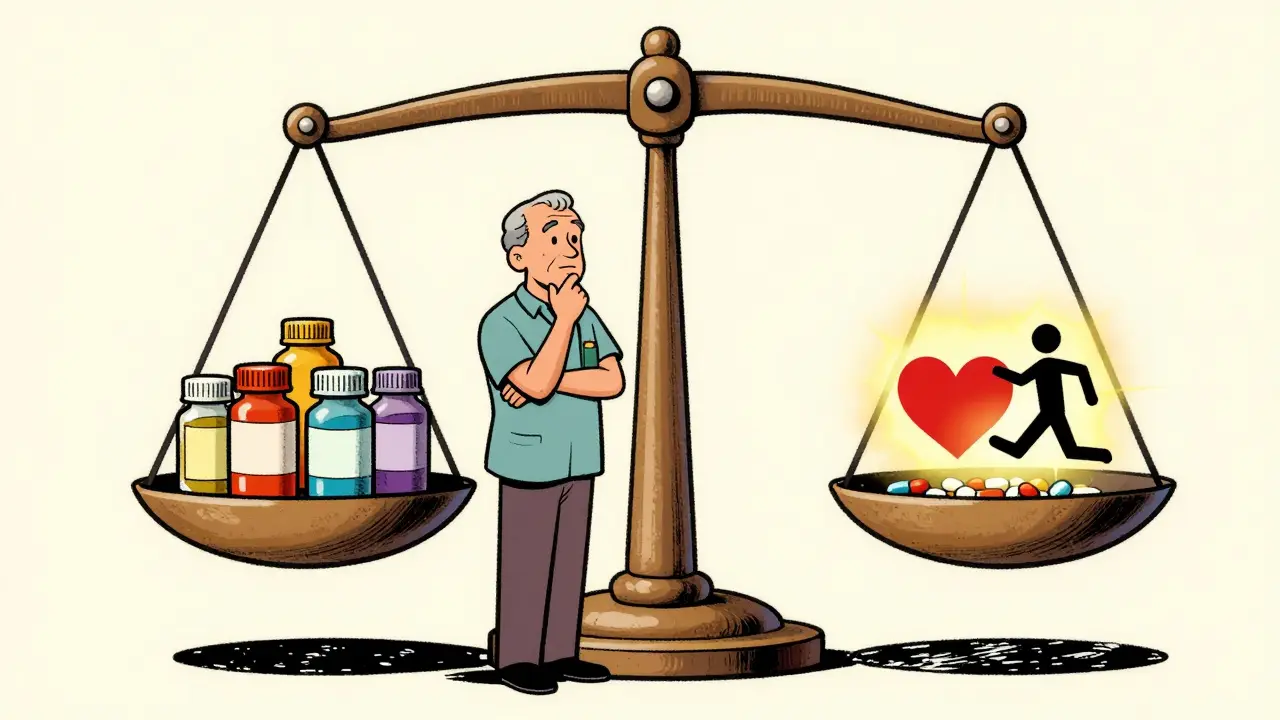
Medication Switch Trade-off Calculator
This simulator demonstrates how "Value Clarification" tools work. In this scenario, you are weighing a standard medication against a newer alternative. Adjust the sliders below to reflect your priorities.
The Medical Facts
Data based on typical clinical averages (example: Warfarin vs. DOAC)
Your Priorities
How do you feel about these factors?
Risk Visualization (per 100 Patients)
Current Med Risk (0/100 events)
New Med Risk (0/100 events)
Analysis Complete
...
Based on your sliders, we calculated which option fits your values best.
Quick Summary: Why This Matters Now
If you've ever struggled with changing medications, you aren't alone. Around 25-50% of patients discontinue medications within the first year, often because they weren't fully prepared for the trade-offs involved. Medication switching decision aids are structured tools designed to fix this gap. They don't just list facts; they help you weigh your personal values against hard data. Here is what you need to know before your next visit.
- Decision aids improve patient knowledge by up to 25% compared to standard care.
- They reduce "decisional conflict," helping you feel confident rather than anxious about changes.
- Digital versions are widely available through major hospital networks and the VA.
- Risks include information overload and the time required to process details during a short appointment.
What Are Medication Switching Decision Aids?
Medication Switching Decision Aids are interactive resources that facilitate shared decision-making between healthcare providers and patients. Unlike a simple brochure, these tools present balanced information about the benefits, risks, and uncertainties associated with continuing current medications versus switching to alternatives. They emerged from the broader shared decision-making movement following the 2001 Institute of Medicine report, which identified informed patient participation as critical to healthcare quality.
The concept started gaining traction when organizations like the Ottawa Hospital Research Institute developed early frameworks in the late 1990s. However, as polypharmacy became more common-meaning patients taking multiple drugs simultaneously-the need for specialized tools grew. By Q1 2024, Intermountain Healthcare was even using AI to personalize these risk presentations based on individual learning styles. Today, these aids are predominantly digital, found on mobile apps or integrated directly into Electronic Health Records (EHR).
You might encounter them under different names, such as patient decision aids (PDAs) or clinical decision support tools. Regardless of the label, the core purpose remains the same: to turn passive recipients of care into informed partners. Dr. Dawn Stacey from the University of Ottawa notes that these tools are crucial when navigating medication changes where adherence depends on accepting risk-benefit trade-offs.
Why Patients Need Them Now More Than Ever
Medication regimens have become incredibly complex. If you manage chronic conditions like diabetes or hypertension, you likely face multiple options where the "best" drug depends on your unique lifestyle. Generic pamphlets often fail here because they present information unidirectionally. Decision aids force explicit consideration of trade-offs.
Consider a scenario involving anticoagulant selection. Traditional counseling might tell you that DOACs are newer, but a decision aid will ask you to weigh bleeding risk against stroke prevention across multiple scenarios. A 2022 systematic review in Patient Education and Counseling found that decision aids outperformed standard information pamphlets by 32% in knowledge retention at 6-month follow-up.
This matters because confusion leads to non-adherence. According to a 2022 JAMA Internal Medicine study, many switches fail due to unaddressed concerns about risks or benefits. For example, a Reddit user named VetMedSurvivor shared that seeing an icon array showing 100 people with 3 bleeding events on DOACs versus 8 on warfarin made the switch decision real for them. Visualizing probability helps bridge the gap between clinical statistics and personal risk tolerance.

How These Tools Actually Work
Effective medication decision aids contain specific technical components designed to maximize understanding without overwhelming you. The VA's MIRECC program framework outlines four essential elements:
- Clear Clinical Question: The tool starts by defining exactly what decision needs to be made, such as switching from metformin to an SGLT2 inhibitor.
- Evidence-Based Risk-Benefit Profiles: Information is presented in absolute terms, e.g., "This medication reduces heart attack risk by 22% over 5 years, from 10% to 7.8%." This avoids misleading relative statistics.
- Visual Representations: Icon arrays often show 100 people, coloring some to represent risk percentages. This makes abstract numbers concrete.
- Value Clarification Exercises: Interactive sections ask you to rank factors like dosing frequency, cost, or fear of specific side effects.
These tools are compatible across platforms, ranging from patient portals to EHR-integrated systems. As of Q2 2024, Epic's App Orchard lists 12 medication decision aid integrations alone. The Ottawa Hospital's suite supports 12 languages and meets WCAG 2.1 AA accessibility standards, ensuring broader reach for diverse populations.
The Evidence: Do They Improve Outcomes?
The data strongly supports the efficacy of these aids, particularly in complex scenarios. Performance metrics from the Cochrane Collaboration's 2017 review of 105 randomized controlled trials demonstrated that patients using these aids scored 15-25% higher on knowledge tests compared to standard care. That is a significant jump that translates to better daily choices.
| Outcome Measure | Standard Care Result | Decision Aid Result | Improvement |
|---|---|---|---|
| Knowledge Retention | Baseline | +25% | High |
| Decisional Conflict | Average | -28% | Moderate |
| Treatment Adherence | Variable | Aligned with Values | Significant |
Beyond knowledge, confidence plays a huge role. A Q3 2023 VA patient satisfaction survey showed 78% of veterans reported increased confidence in medication decisions after using the VA's anticoagulant decision aid. Success stories frequently highlight avoided adverse events, such as a patient declining a switch after a decision aid revealed an unacceptably high risk of a side effect they feared.
Potential Pitfalls and Limitations
While the benefits are clear, relying solely on these tools isn't a magic bullet. One major limitation is time. Primary care physicians report 68% adoption barriers due to workflow disruption. A 2023 Annals of Internal Medicine study noted that initial consultations take 12.7 minutes longer than standard visits. While proficiency reduces this to nearly 5 minutes extra, the initial learning curve is steep for both doctors and patients.
There is also the risk of information overload. In a Mayo Clinic usability study, 31% of users reported feeling overwhelmed by too many numbers. Dr. John Ioannidis of Stanford University warned in 2021 that over-reliance on probabilistic information could overwhelm patients ill-equipped to process complex stats. Additionally, decision aids work best for preference-sensitive decisions where multiple evidence-based options exist. They underperform in emergencies requiring immediate changes or for patients with severe cognitive impairment (MMSE scores below 24).
Another concern involves false equivalence. Critics note that sometimes aids present two options as equal when the evidence base differs significantly. Regulatory bodies like the FDA issue warning letters to developers who minimize serious risks. In 2023, 12 warnings were issued for decision aids lacking balanced risk presentation. Therefore, always check if an aid comes from a reputable source like the VA, Mayo Clinic, or Ottawa Hospital.

Implementing Decision Aids in Your Care Routine
If your provider uses these tools, the workflow typically follows a 4-step process defined by the VA:
- Identification: Clinician spots a decision point (e.g., switching antidepressants).
- Preparation: You receive the aid 24-72 hours before the visit to review at home.
- Discussion: During the appointment, focus shifts to value clarification.
- Documentation: The joint decision is recorded in the EHR.
For clinicians, implementation requires basic communication training. The AHRQ's 2023 training module reports 87% clinician competence after just 4 hours of focused training. Learning curve analysis shows clinicians need 3-5 encounters to become proficient.
The Future of Decision Support
Looking ahead, the landscape is shifting rapidly toward AI-powered personalization. The Commonwealth Fund predicts 75% adoption in value-based care settings by 2027. Sustainability remains a challenge, however, as only 38% of hospital systems have dedicated funding for maintenance. Without standardized updating processes, aids risk becoming obsolete, especially in fast-moving fields like oncology where FDA labels change frequently. For now, however, they remain one of the most effective tools for managing the complexity of modern medicine.
Frequently Asked Questions
Are decision aids free for patients?
Most reputable decision aids hosted by public health institutions like the Ottawa Hospital or the VA are free. Commercial vendors may charge subscription fees, but these are usually covered by insurance plans in managed care settings.
Can I use a decision aid without a doctor?
You can review materials independently, but these tools are designed to be used alongside a healthcare professional. Medical context is vital to interpreting risk probabilities correctly for your specific health status.
Do these tools work for mental health medications?
Yes, 68% of VA facilities currently use medication decision aids for mental health medications. They are particularly helpful for switching antidepressants where side effect profiles vary greatly between individuals.
How do I find a trusted decision aid?
Look for libraries maintained by the Ottawa Hospital Research Institute, Mayo Clinic, or the Veterans Affairs MIRECC program. Avoid random websites that do not cite sources or update their evidence regularly.
Will my doctor have enough time to use these?
Initially, appointments may run 5-12 minutes longer. However, once the team is proficient, the added time decreases significantly. Many clinics now provide aids for patients to complete at home beforehand to save office time.


Hudson Nascimento Santos
April 2, 2026 AT 03:12The concept of agency in healthcare has always been a complex dance between trust and autonomy. When we hand over our choices to algorithms, we risk losing something human. Yet the statistics presented here regarding retention are undeniable in their magnitude. It is fascinating how visual data changes perception more than dry numbers alone. We see this shift constantly in how public policy meets individual experience. The integration of these aids into electronic records suggests a systemic change. Doctors are not just prescribers anymore but facilitators of informed consent. That requires a fundamental shift in the traditional power dynamic of the clinic room. Patients deserve tools that empower rather than confuse them during stressful moments. The trade-offs mentioned regarding bleeding risks highlight why clarity is non-negotiable. If the tool fails to explain uncertainty, it becomes propaganda rather than aid. We must scrutinize the source behind the information before accepting the guidance offered. Accessibility standards like WCAG are crucial for ensuring no one is left behind digitally. Ignoring cognitive load limits might lead to better metrics but worse health outcomes overall. Ultimately the goal should remain shared understanding rather than mere compliance with orders.
Mark Zhang
April 2, 2026 AT 23:36It is wonderful to see resources focusing on the emotional weight of these decisions. Many of us struggle to advocate for ourselves when the medical jargon gets too dense. These platforms can provide a bridge back to normal conversation. Having a clear view of the options makes the scary stuff a little bit manageable. It gives everyone a seat at the table which matters so much for mental peace.
Vicki Marinker
April 3, 2026 AT 13:12The methodology remains significantly flawed in many published examples. While the intention appears noble, the execution frequently lacks necessary rigour in its design phase. One cannot simply assume that presenting data equates to genuine understanding. There is a distinct lack of longitudinal study regarding long term adherence rates using these aids.
The Charlotte Moms Blog
April 5, 2026 AT 05:57Your confidence in the system is misplaced!!! They cherry pick the data!!!! It highlights only what works for the insurance companies!!!!! The adverse effects are buried in the fine print!!!! It is a classic case of corporate manipulation disguised as help!!!!! Be careful with your health!!!!
Aysha Hind
April 6, 2026 AT 05:18Big Pharma loves these kinds of digital distractions to hide the truth. The real solution involves removing the drugs entirely from the equation. Why would hospitals promote tools that just sell you different poisons? It is a sinister matrix of profit over wellbeing. They want you confused so you stay dependent on their prescriptions forever.
sophia alex
April 6, 2026 AT 23:32They are hiding the truth from us common people :( Only the elite get the good meds without side effects. It is a disaster waiting to happen for the average family. :( We are treated like guinea pigs in this system. Our rights are being stripped away slowly :(
Rachelle Z
April 8, 2026 AT 07:57I am totally loving the visuals here!!! 😍 Finally some transparency in the mess of medicine!! 😲 But seriously!! Is anyone else feeling overwhelmed by all the charts?! 🙈👀
Hope Azzaratta-Rubyhawk
April 9, 2026 AT 18:57Implementation is mandatory for true safety. You MUST utilize these resources for your own protection. Ignoring this advice leads to preventable complications. The protocol demands full engagement from the patient population. Failure to adopt these methods is unacceptable in modern care.
Lawrence Rimmer
April 11, 2026 AT 12:23These tools seem designed to shift liability onto the patient instead of improving care quality.