Vitamin K Intake Tracker for Warfarin Users
How to Use This Tool
Track your vitamin K intake to maintain stable INR levels. This tool helps you monitor your daily vitamin K consumption according to your gender-specific needs.
Your Vitamin K Targets
Add Your Foods
Your Intake History
Your Vitamin K Consistency
If you're taking warfarin, you've probably heard that vitamin K affects your blood thinning. But here’s the truth: warfarin doesn’t mean you have to give up spinach, kale, or broccoli. The real problem isn’t eating these foods-it’s eating them inconsistently. One day you have a big salad, the next day you eat pasta with tomato sauce, and suddenly your INR spikes or crashes. That’s not bad luck. That’s diet variability.
Why Vitamin K Matters More Than You Think
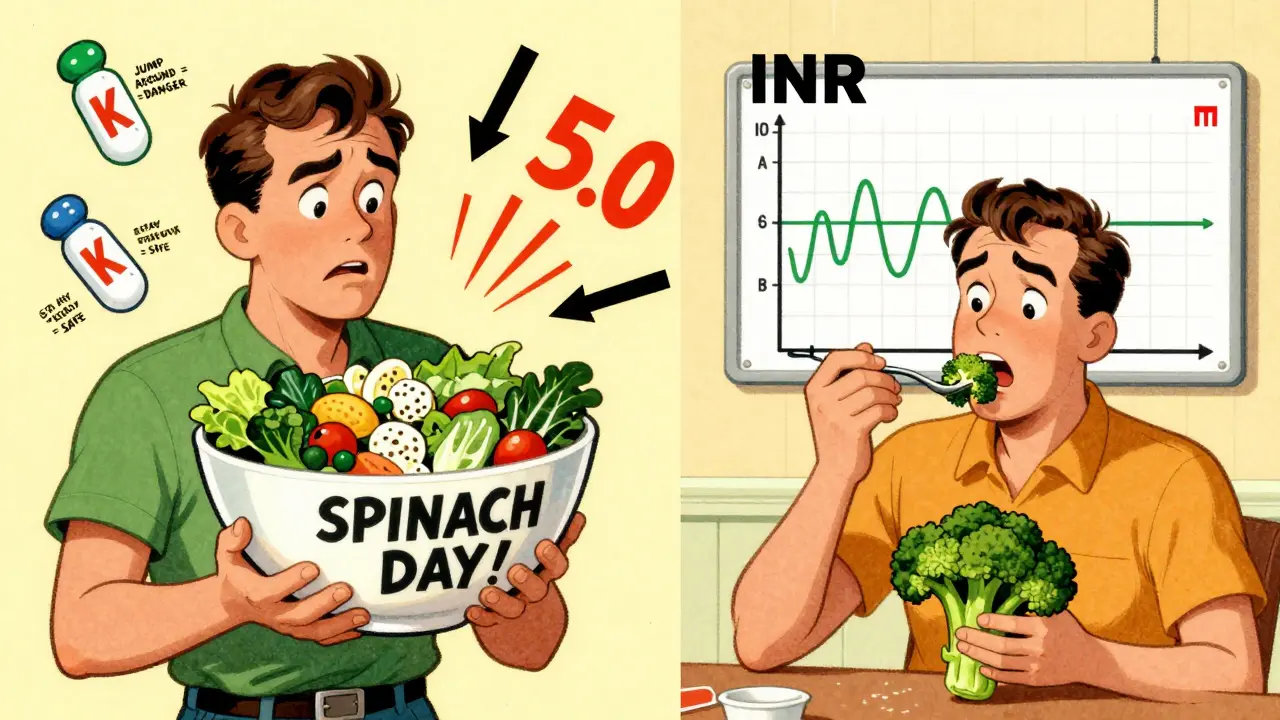
Warfarin works by blocking your body’s ability to recycle vitamin K. Without enough active vitamin K, your blood can’t make the clotting proteins it needs-Factors II, VII, IX, and X. That’s why your blood takes longer to clot. But here’s the catch: vitamin K doesn’t disappear after you eat it. It builds up in your liver. If your intake jumps around, your body’s clotting system gets confused. One day, you get a big dose of vitamin K from a serving of cooked kale (547 µg per cup), and your INR drops. The next day, you skip the greens, and your INR rises again.
Studies show patients with inconsistent vitamin K intake are 2.3 times more likely to have INR levels outside the safe range. That means more trips to the clinic, more blood tests, and a higher risk of dangerous clots or bleeding. The goal isn’t to avoid vitamin K. It’s to make your intake predictable.
The Numbers Behind the Diet
The Recommended Dietary Allowance (RDA) for vitamin K is 90 µg per day for women and 120 µg for men. But most people in the U.S. already hit that mark-men average 122 µg, women 93 µg. So you’re probably not deficient. You’re just erratic.
Research from the University of Iowa found that people who ate more than 250 µg of vitamin K daily needed 22% higher warfarin doses to stay in range. That’s because their bodies had more vitamin K to work with, so warfarin had to work harder. But here’s the twist: when those same people kept their intake steady, their INR stabilized-even at higher doses.
That’s why doctors now say: Don’t restrict. Consistently maintain. The American College of Chest Physicians updated their guidelines in 2021 to explicitly warn against vitamin K restriction. It doesn’t help. It hurts. Restricting vitamin K can actually cause your body to become more sensitive to small changes, making your INR even more unstable.
What Foods Have Vitamin K? (And How Much?)
You don’t need to memorize every food. But you do need to know which ones are high-and how to keep them steady.
- 1 cup cooked spinach: 889 µg
- 1 cup raw kale: 547 µg
- 1 cup cooked broccoli: 220 µg
- 1 cup raw lettuce: 47 µg
- 1 egg: 20 µg
- 3 oz chicken breast: 2 µg
- 1 tablespoon olive oil: 10 µg
Notice something? Spinach and kale are sky-high. But so are Brussels sprouts, turnip greens, and parsley. You don’t have to avoid them. Just pick one or two and eat them the same way, same amount, same days each week.
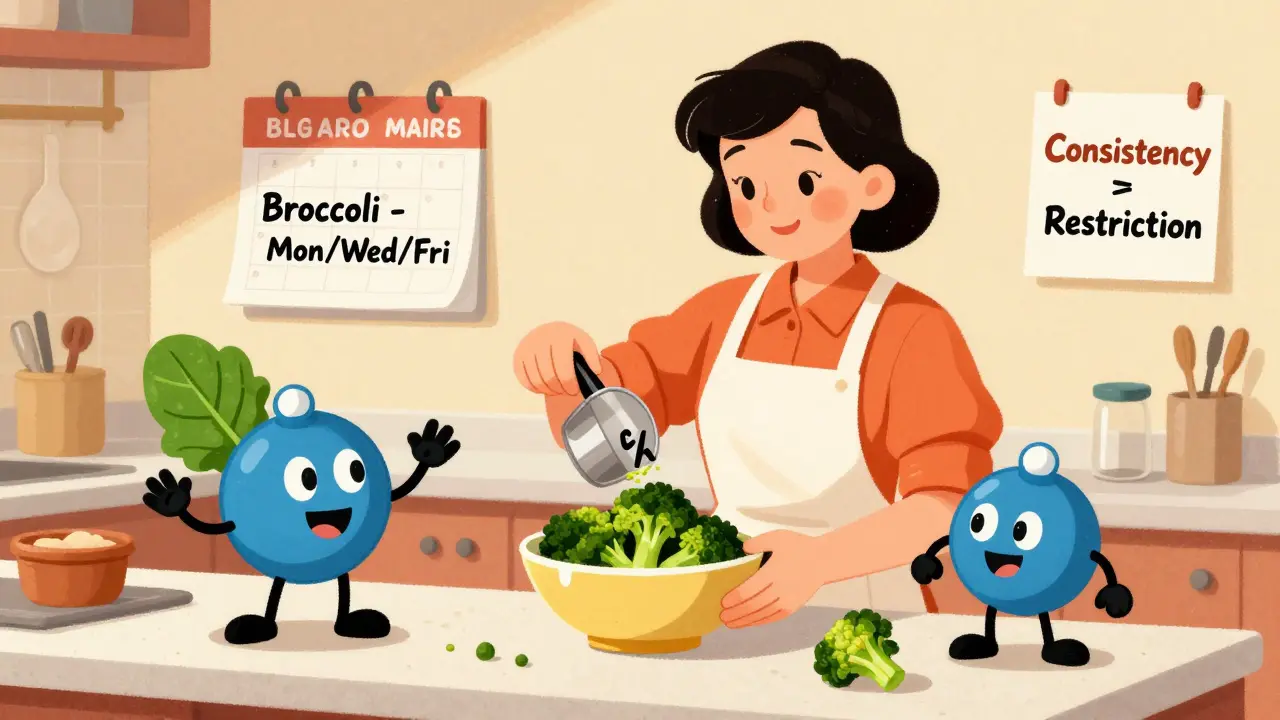
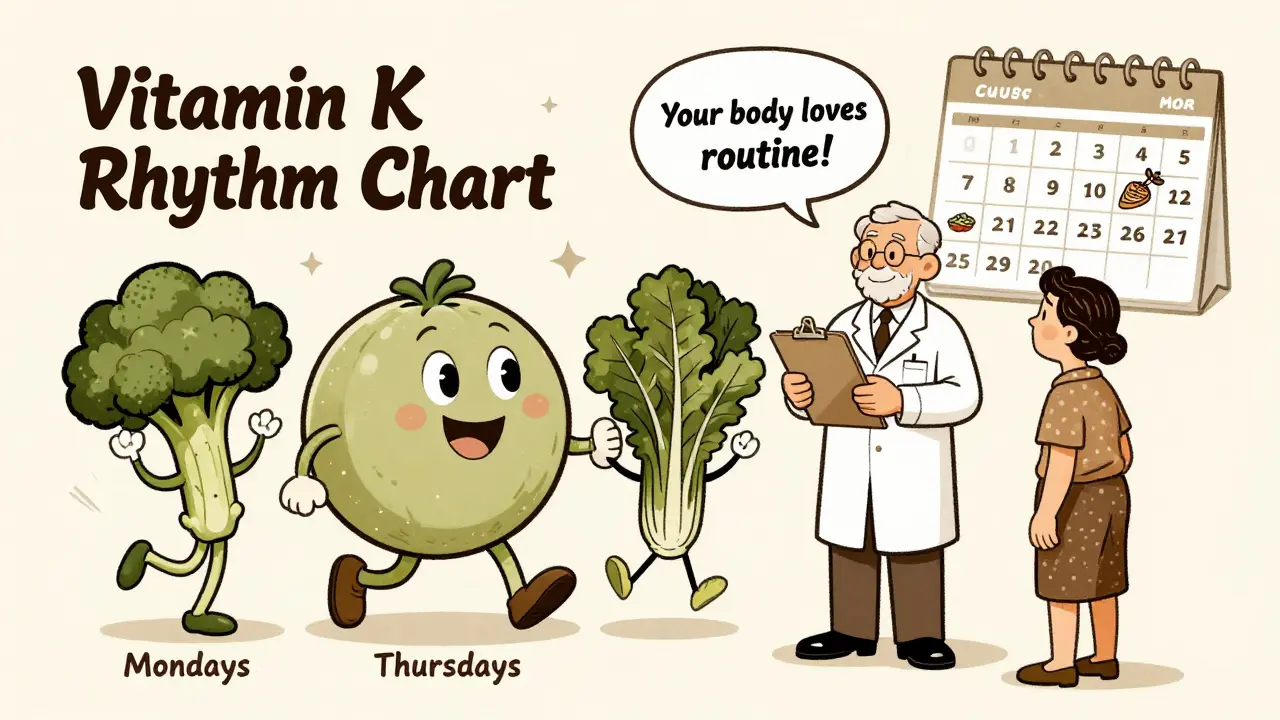
For example: if you eat ½ cup cooked broccoli on Monday, Wednesday, and Friday, stick to that. Don’t swap it out for a big salad on Tuesday. Don’t have kale smoothies on weekends and nothing all week. Your body needs rhythm.
How to Build a Consistent Plan
Here’s how real people do it:
- Track for 4-6 weeks. Use a food diary or an app like Warframate (iOS/Android). Write down everything you eat, especially greens. Don’t guess. Use measuring cups. Studies show visual estimates are wrong 45% of the time.
- Find your baseline. After a few weeks, you’ll see your average daily intake. If you’re eating 100 µg/day on average, aim to stay within ±20%-so 80 to 120 µg.
- Plan your meals. Pick a consistent source. Maybe it’s ½ cup cooked broccoli every day. Or 1 cup mixed greens twice a week. It doesn’t matter what it is, as long as it’s the same.
- Use a template. One simple daily plan: 1 scrambled egg (20 µg), ½ cup cooked broccoli (102 µg), 3 oz chicken (2 µg), and 1 tbsp olive oil (10 µg) = 134 µg. That’s within range. Do it every day.
- Check in with your pharmacist. They’re your best ally. Ask them to review your food log. Many clinics now offer free dietary counseling with anticoagulation pharmacists. Patients who get this support hit 82% time in therapeutic range-compared to 63% without it.
What About Supplements and New Foods?
Don’t start a vitamin K supplement unless your doctor or pharmacist tells you to. But if you’ve been stable and want to add a new food-say, a green smoothie with kale-talk to your provider first. A sudden change can throw off your INR in days.
Same goes for herbal supplements. Green tea, ginseng, garlic, and even cranberry juice can interact with warfarin. You don’t need to avoid them forever, but don’t start them without checking in. Your INR is sensitive to more than just diet.
Genetics Play a Role Too
Not everyone responds the same way. Some people have genetic variants in the VKORC1 or CYP2C9 genes that make them extra sensitive to vitamin K. If you’ve had trouble staying in range despite eating consistently, ask your doctor about genetic testing. A 2023 study showed that people with these variants need tighter control-±10% variation, not ±20%. For them, even small changes matter more.
But even if you don’t have the gene, consistency still helps. The data is clear: predictable intake = stable INR.
Real Stories, Real Results
One Reddit user, u/WarfarinWarrior, shared that their INR was all over the place-sometimes 1.5, sometimes 5.0. They started tracking. They began eating exactly 1 cup of mixed greens every Tuesday and Thursday. Within weeks, their time in range jumped from 45% to 78%.
Another patient, from the Stop The Clot Foundation forum, said she used to avoid all greens because she was scared. Her INR was always low. Her pharmacist told her to eat spinach every day-same amount, same time. Her INR stabilized. She’s been off the emergency room radar for two years.
These aren’t outliers. They’re the norm when you stop treating vitamin K like an enemy and start treating it like a rhythm.
What Happens If You Don’t Change?
Every year, 31% of people on warfarin end up in the ER because their INR went too high or too low. In more than half of those cases, the cause was inconsistent diet. That’s not a coincidence. That’s a pattern.
Centers that train patients on vitamin K consistency see 1.8 fewer hospitalizations per 100 patients each year. That’s life-changing. It’s not just about avoiding bleeding. It’s about living without fear-knowing your blood is steady, your food is safe, and your health is in your hands.
Bottom Line: Eat Like a Pro
You don’t need a perfect diet. You need a consistent one.
Here’s what to do:
- Don’t restrict vitamin K. It’s not the enemy.
- Don’t guess portions. Use measuring cups.
- Find your go-to foods and eat them the same way, every week.
- Track your intake for the first month. Then check in with your pharmacist.
- Don’t change your diet suddenly. Talk to your care team first.
Warfarin isn’t about fear. It’s about rhythm. And you’ve got this.
Can I eat spinach while taking warfarin?
Yes, you can-and you should, if you eat it consistently. Spinach is high in vitamin K, but avoiding it makes your INR more unstable. The key is to eat the same amount on the same days each week. One cup of cooked spinach three times a week is better than a big salad one day and none for a week.
Should I take a vitamin K supplement?
Only if your doctor or pharmacist recommends it. Some patients with unstable INR benefit from a daily 150 µg supplement, but this is done under supervision. Self-prescribing can be dangerous. Never start a supplement without talking to your care team first.
How often should I get my INR checked?
When you first start warfarin or change your diet, you may need checks every 3-7 days. Once your INR is stable and your diet is consistent, most people check every 4-6 weeks. But if you’ve had recent fluctuations, your provider may ask for more frequent testing until things settle.
Can alcohol affect my INR?
Yes. Heavy or binge drinking can increase your INR and raise bleeding risk. Even moderate drinking (more than 1-2 drinks a day) can interfere with how warfarin is processed. If you drink, keep it consistent-same amount, same days. Don’t save it all for the weekend.
What if I forget to eat my usual vitamin K food one day?
Don’t panic. One missed day won’t ruin your INR. But if it happens often, your levels will drift. If you skip your usual serving, try to eat a small amount of another vitamin K source that day-like ½ cup cooked broccoli or a hard-boiled egg. Avoid large swaps. Consistency over time matters more than perfection.
Does cooking affect vitamin K levels?
Cooking doesn’t destroy vitamin K. In fact, cooking greens like spinach or kale concentrates them by reducing volume, so you get more per cup. Raw kale has more vitamin K than cooked, but most people eat cooked greens in larger portions. The key is consistency in portion size, not cooking method.
How long does it take to see results from a consistent diet?
Most people see improvement in their INR stability within 2-4 weeks of consistent eating. But it can take up to 6 weeks for your body to fully adjust. Track your intake and INR results during this time. You’ll start to see patterns-like how your INR responds after eating your usual portion of broccoli or kale.

Sophia Daniels
December 26, 2025 AT 02:42Okay but let’s be real-most people don’t track their vitamin K like it’s a crypto portfolio. I used to eat kale smoothies every Monday and then forget for three weeks. My INR went from 2.1 to 5.8 in 72 hours. ER visit. IV fluids. A nurse yelling at me while I cried over a banana. Now I eat one cup of spinach every Thursday. No drama. No panic. Just rhythm. Thank you, OP, for saying this out loud.
Brittany Fuhs
December 26, 2025 AT 05:21While I appreciate the sentiment, I must emphasize that dietary consistency is not merely a lifestyle choice-it is a clinical imperative. The data you cite, while anecdotal in presentation, aligns with the 2021 ACCP guidelines which explicitly reject arbitrary restriction in favor of structured maintenance. One cannot, however, ignore the confounding variables of genetic polymorphism, particularly VKORC1 variants, which account for up to 30% of warfarin sensitivity. Without pharmacogenomic screening, even perfect dietary adherence may yield suboptimal outcomes.
Nikki Brown
December 27, 2025 AT 10:15I’m so tired of people treating warfarin like a diet trend. You don’t get to pick and choose when to be responsible. One day you eat kale, next day you eat salad, next day you’re in the hospital. It’s not hard. It’s not complicated. It’s just discipline. And if you can’t manage that, maybe you shouldn’t be on warfarin. 🙄
Peter sullen
December 27, 2025 AT 15:36It is imperative to underscore the significance of dietary adherence in anticoagulation management. The pharmacokinetic variability associated with vitamin K intake directly modulates the pharmacodynamic response to warfarin, thereby increasing the coefficient of variation in INR measurements. Empirical evidence from longitudinal cohort studies indicates that patients maintaining a daily vitamin K intake within ±20% of their baseline exhibit a statistically significant reduction in time outside therapeutic range (TTR), with p-values < 0.001. Furthermore, pharmacist-led dietary counseling demonstrates a 19% improvement in TTR versus standard care protocols.
Steven Destiny
December 28, 2025 AT 13:29Stop overcomplicating this. You don’t need an app. You don’t need a spreadsheet. You just need to eat the same damn greens on the same days. If you can’t do that, you’re not trying. And if you’re too lazy to eat broccoli three times a week, don’t blame your INR. Blame yourself. I’ve been on warfarin for 8 years. I eat ½ cup broccoli every Tuesday, Thursday, Saturday. Done. No drama. No ER. You can too.
Fabio Raphael
December 30, 2025 AT 09:06I’ve been on warfarin for five years and honestly, this post changed everything for me. I used to avoid greens because I was scared. Then I started eating one boiled egg and a tablespoon of olive oil every morning-same time, same amount. No more panic. No more missed work because my INR was off. I still check in with my pharmacist every month. She’s a lifesaver. Thank you for sharing this. It’s not just advice-it’s peace of mind.
Amy Lesleighter (Wales)
December 31, 2025 AT 01:40just eat the same thing same days. no need to overthink. i eat 1 cup cooked spinach tues/thurs/sat. thats it. my inr is stable. no apps. no stress. just food. you got this.
Becky Baker
December 31, 2025 AT 23:30Y’all act like this is rocket science. I’m from Texas. I eat collard greens every Sunday. That’s it. No measuring cups. No apps. Just my grandma’s recipe. My INR’s been steady for 3 years. You don’t need to be a scientist. You just need to be consistent. And maybe stop listening to all these overeducated people telling you to track everything like it’s a startup.
Rajni Jain
January 1, 2026 AT 00:02As someone from India, I was scared to eat spinach because I thought it would mess up my warfarin. But my doctor said, 'Eat it, but eat it every day.' Now I have saag paneer twice a week-same amount, same day. My INR is better than it’s ever been. You don’t have to give up your culture. You just have to make it steady. Thank you for this. I finally feel safe.
Erwin Asilom
January 2, 2026 AT 20:08Consistency is the cornerstone of anticoagulation stability. The data is unequivocal. However, I would add that meal timing and concurrent medication use (e.g., antibiotics, NSAIDs) can also modulate warfarin metabolism. While dietary vitamin K is the primary modifiable factor, a holistic approach-including medication reconciliation and avoiding acute dietary shifts-is essential for long-term success. I recommend patients maintain a weekly food log for at least 30 days prior to INR adjustment.
Sumler Luu
January 4, 2026 AT 02:37I used to skip my greens for weeks because I thought I was 'being good' by avoiding them. Then my INR kept creeping up. My pharmacist told me to eat a little every day-not a lot, just a little. Now I have a hard-boiled egg and a spoon of olive oil every morning. It’s boring. But it works. I’m not perfect. But I’m stable. And that’s enough.
sakshi nagpal
January 4, 2026 AT 13:04This is the kind of post that makes me believe medicine doesn’t have to be intimidating. I’m from Delhi, and we eat a lot of greens-methi, palak, mustard. I used to worry I’d bleed out. Now I eat one cup of cooked palak every Tuesday and Friday. No more fear. Just routine. Thank you for normalizing this. It’s not about restriction. It’s about rhythm.
Sandeep Jain
January 4, 2026 AT 16:15my wife is on warfarin and she started doing this and her inr went from wild to steady. i never knew vitamin k was so important. we just make sure she eats the same curry with spinach every tuesday and friday. no fancy stuff. just consistency. you dont need to be perfect. just steady.