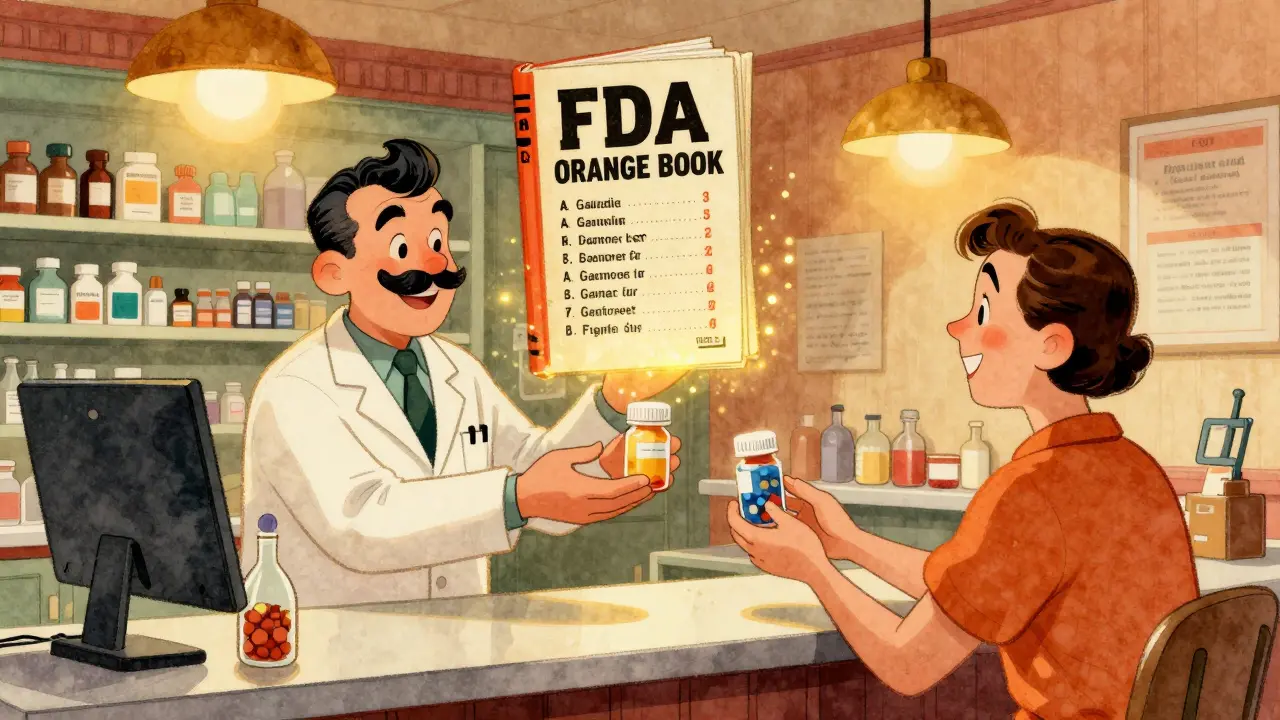
The FDA Orange Book is the official government list that tells you which generic drugs are approved and safe to swap for brand-name medicines. It’s not just a directory-it’s the rulebook pharmacists, doctors, and insurers use every day to decide if a cheaper generic can legally replace a more expensive brand. If you’ve ever picked up a prescription and been handed a different-looking pill with the same name, the Orange Book is why that happened.
What Exactly Is the FDA Orange Book?
The full name is Approved Drug Products With Therapeutic Equivalence Evaluations. It was created in 1984 under the Hatch-Waxman Act to balance two goals: letting generic drugs enter the market quickly, while still protecting the patents of original drugmakers. Today, it contains over 16,000 approved drug products-both prescription and over-the-counter. Roughly 90% of all U.S. prescriptions are filled with generics, and the Orange Book is the reason that number is so high.The Orange Book doesn’t just list drugs. It tells you which ones are considered therapeutically equivalent-meaning they work the same way in your body as the brand-name version. That’s critical because not all generics are created equal. Some might look different, have different fillers, or come in different shapes. But if they’re marked as equivalent in the Orange Book, you can trust they’ll do the same job.
How Do Generic Drugs Get Listed?
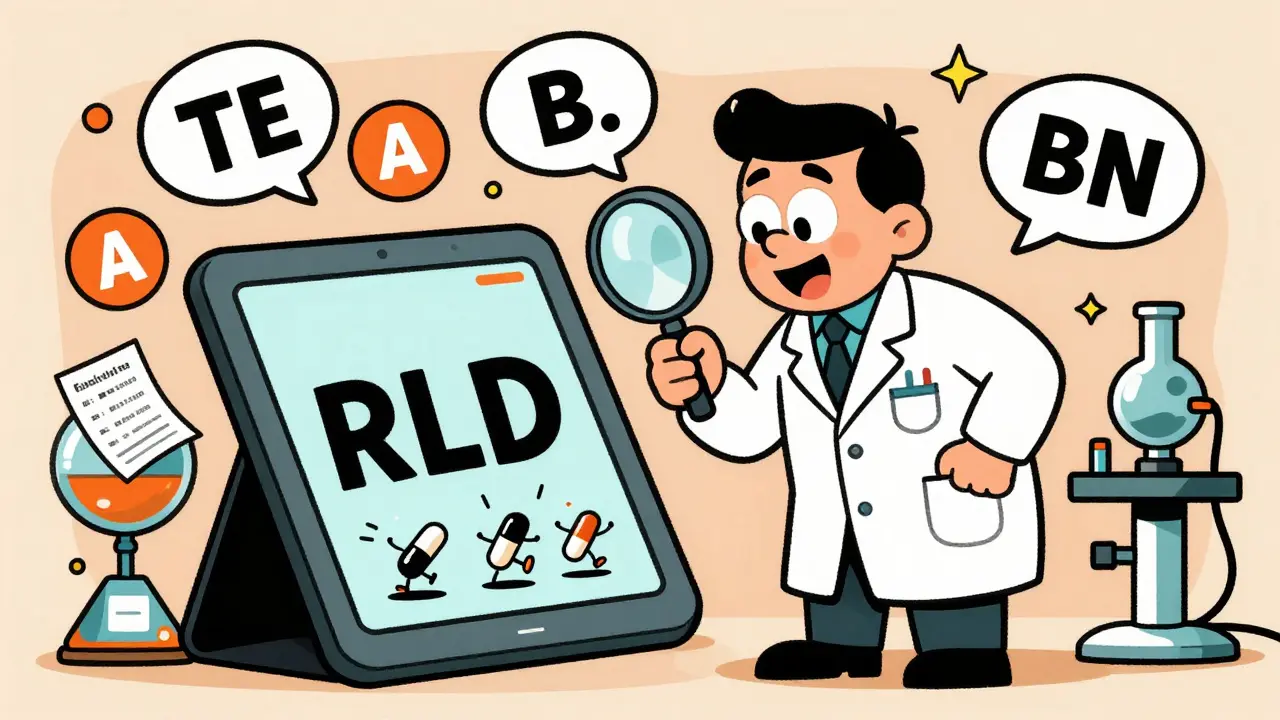
Generic drug companies don’t start from scratch. They use a shortcut called the Abbreviated New Drug Application (ANDA). Instead of running expensive clinical trials, they only need to prove one thing: their version is bioequivalent to the original brand. That means it releases the same amount of active ingredient into your bloodstream at the same rate.To do this, they pick a Reference Listed Drug (RLD)-the brand-name product the FDA has already approved. The generic must match the RLD exactly in strength, dosage form, and route of administration. For example, if the RLD is a 10mg tablet taken by mouth, the generic must be the same.
Once the FDA approves the ANDA, the generic gets added to the Orange Book. It’s marked as “No” in the RLD column, while the original brand is marked “Yes.” You’ll also see a Therapeutic Equivalence (TE) Code next to each drug. These codes are short but powerful:
- A = Therapeutically equivalent. Safe to substitute.
- B = Not equivalent. May have issues with absorption or effectiveness.
- BN = Single-source drug. No generics approved yet.
For example, if you search for Lipitor (atorvastatin), you’ll see the brand listed as RLD with an “A” code. Then you’ll see dozens of generics-all with “A” codes too. That means your pharmacist can switch you to any of them without asking your doctor.
What About Authorized Generics?
There’s another kind of generic you might not know about: authorized generics. These aren’t made by generic companies at all. They’re the exact same pills as the brand-name drug, just sold without the brand label. For example, a generic version of Adderall might be made by the same company that makes the brand version, just in a plain bottle.Here’s the twist: authorized generics don’t appear in the Orange Book. They’re listed under the original brand’s New Drug Application (NDA). The FDA keeps a separate public list of these drugs, updated quarterly. That’s because they’re not ANDAs-they’re still under the original patent holder’s approval.
Why does this matter? Because if you’re comparing prices and see a “generic” that looks identical to the brand, it might be an authorized generic. It’s not cheaper because it’s made differently-it’s cheaper because it’s sold without marketing costs.
Patents and Exclusivity: The Hidden Rules
The Orange Book isn’t just about equivalence-it’s also a patent tracker. When a brand-name company gets approval, they must list any patents covering the drug. These include:- Patents on the active ingredient
- Patents on how the drug is made
- Patents on how the drug is used (like treating high blood pressure or depression)
Each patent gets a unique code (like U-123) and an expiration date. If a generic company wants to launch before a patent expires, they must challenge it in court. That triggers a 30-month delay on approval-known as the “30-month stay.” This is why some generics take years to appear, even after the brand’s patent is about to expire.
Between 2005 and 2022, the number of patents listed in the Orange Book jumped from 8,000 to over 14,000. Critics say this is “patent evergreening”-companies filing weak patents just to block competition. The FDA says it’s reviewing these listings more closely now to stop abuse. In January 2023, new rules came in to prevent companies from listing patents that don’t actually cover the drug’s approved use.
How to Use the Orange Book (Even If You’re Not a Pharmacist)
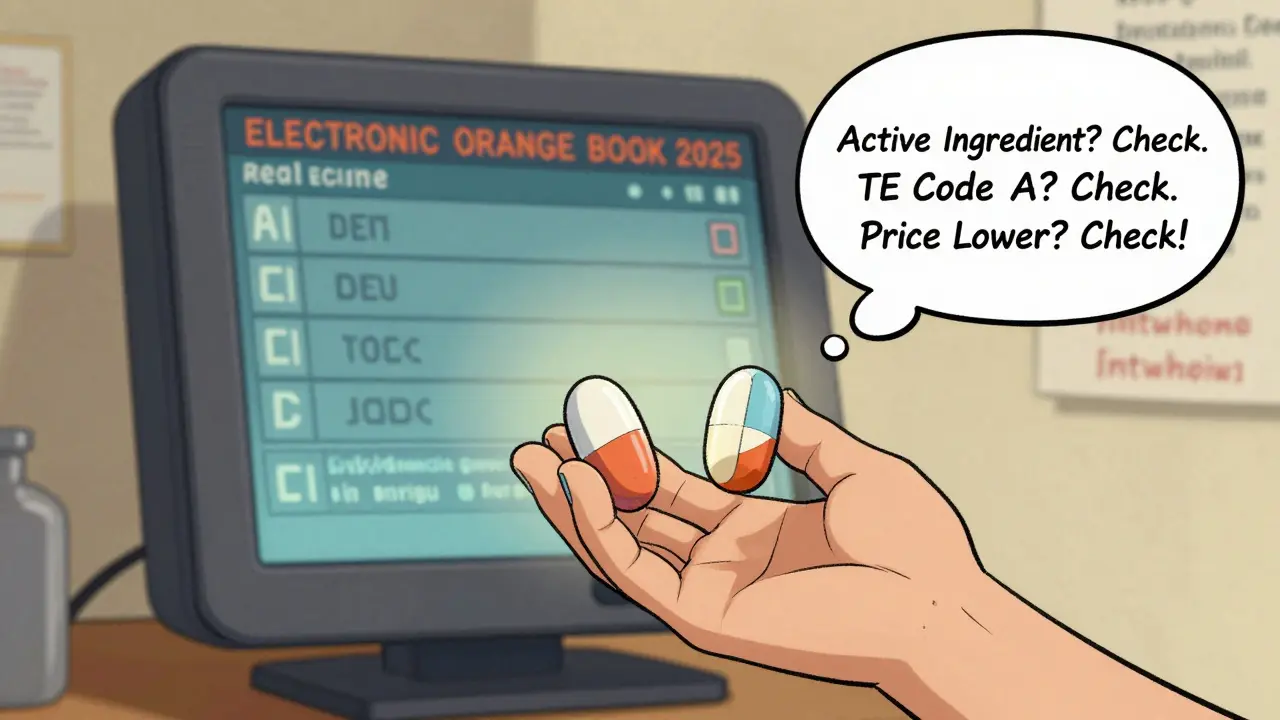
You don’t need a pharmacy degree to find what you need. The Electronic Orange Book is free and easy to use. Here’s how:- Go to the FDA’s website and open the Electronic Orange Book.
- Search by the drug’s active ingredient (e.g., “metformin”) or brand name (e.g., “Glucophage”).
- Look at the results grouped by dosage form (tablet, injection, etc.).
- Find the RLD (marked “Yes”) and all the generics (marked “No”).
- Check the TE Code. If it’s “A,” you can substitute safely.
Tip: If you’re looking at a combination drug like a pill with two active ingredients, search for both. For example, if you’re checking a blood pressure drug with lisinopril and hydrochlorothiazide, search both names separately. The system won’t find it if you only type one.
Why the Orange Book Matters to You
If you’re paying for prescriptions, this affects your wallet. Studies show that when a drug has multiple generics listed in the Orange Book with “A” codes, prices drop 18-22% compared to single-source drugs. That’s hundreds of dollars a year for some medications.It also affects your health. In 2023, a survey of pharmacists found that 62% had experienced confusion because state laws didn’t match Orange Book codes. For example, a state might allow substitution for a “B” code drug, even though the FDA says it’s not equivalent. That’s why it’s smart to ask your pharmacist: “Is this generic listed as ‘A’ in the Orange Book?”
Pharmacy systems now integrate Orange Book data automatically. But even with technology, human review is still needed. A 2022 report showed 41% of pharmacy techs still need extra training to interpret TE codes correctly-especially for complex drugs like inhalers or eye drops.
What’s Changing in 2025?
The FDA is working on a Digital Orange Book, set to launch in 2025. This new version will update in real time instead of monthly. It’ll also have better search tools, clearer TE codes, and data that links directly to electronic health records.Why? Because today’s drugs are more complicated. Inhalers, patches, and injectable suspensions don’t always behave the same way even if they have the same ingredients. The FDA is testing new ways to rate equivalence for these products-something the current system struggles with.
Also, the Biologics Price Competition and Innovation Act created a parallel system called the Purple Book for biologic drugs like Humira or Enbrel. But the Orange Book still covers the vast majority of pills, injections, and creams you take every day.
Common Mistakes and Misunderstandings
Many people think the Orange Book lists all generics. It doesn’t. Only those approved by the FDA do. Some products are “tentatively approved”-meaning they’re ready to go, but a patent is still in effect. These appear on Drugs@FDA, not the Orange Book.Another myth: “If it’s generic, it’s the same.” Not always. A “B” code means there’s a known issue-maybe the drug doesn’t absorb well in some people. If your doctor prescribes a drug with a “B” code, don’t automatically accept a substitute. Ask why.
And remember: OTC drugs (like ibuprofen or allergy pills) are listed in the Orange Book, but they’re not evaluated for therapeutic equivalence. That’s because they’re not prescribed, and substitution isn’t regulated the same way.
What does it mean if a drug has a ‘B’ code in the Orange Book?
A ‘B’ code means the drug is not considered therapeutically equivalent to the brand-name version. This could be because of differences in how the drug is absorbed, released, or delivered. For example, some extended-release tablets or inhalers may have different formulations that affect performance. Pharmacists cannot substitute a ‘B’ code drug without a doctor’s permission, and patients should be cautious about switching.
Are all generic drugs cheaper than brand names?
Most are-but not always. Authorized generics (made by the brand company) are often priced close to the original brand. Also, if a drug has only one generic on the market (a ‘BN’ code), prices may stay high because there’s no competition. The biggest price drops happen when multiple generics with ‘A’ codes enter the market.
Can I trust a generic drug if it looks different from the brand?
Yes-if it has an ‘A’ code in the Orange Book. Generic drugs are required to have the same active ingredient, strength, and performance as the brand. Differences in color, shape, or filler ingredients don’t affect how well the drug works. The FDA tests these rigorously before approval.
Why don’t I see all my drugs in the Orange Book?
Some drugs aren’t listed because they’re not approved under the ANDA pathway. This includes over-the-counter drugs without therapeutic equivalence ratings, drugs that were discontinued, and biologics (which are in the Purple Book). Also, if a generic is only tentatively approved, it won’t appear until the patent expires or is resolved.
How often is the Orange Book updated?
The Electronic Orange Book is updated every month. New approvals, patent changes, and discontinued products are added within 30 days of FDA action. However, the public version you see online may take a few extra days to reflect changes due to processing delays.
Next Steps: What You Can Do
If you’re on a long-term medication, check the Orange Book before your next refill. Search your drug by name or ingredient. See how many generics are listed with ‘A’ codes. If you’re paying full price for a brand, there might be a cheaper, equivalent option.Ask your pharmacist: “Is this generic listed as therapeutically equivalent in the FDA Orange Book?” If they don’t know, ask for the TE code. Most pharmacists have access to the database. If they say no, you might be getting a more expensive version than necessary.
And if you’re confused by a change in your pill’s appearance, don’t assume it’s a mistake. It might just be a new generic. Check the Orange Book. You’ll save money-and you’ll know exactly why.
Betty Bomber
January 27, 2026 AT 10:47Robin Van Emous
January 29, 2026 AT 04:54Angie Thompson
January 30, 2026 AT 09:08Mohammed Rizvi
January 31, 2026 AT 22:34Shawn Raja
February 2, 2026 AT 22:25Ryan W
February 4, 2026 AT 00:48Allie Lehto
February 4, 2026 AT 13:56TONY ADAMS
February 5, 2026 AT 00:22Napoleon Huere
February 5, 2026 AT 07:03Shweta Deshpande
February 6, 2026 AT 14:09Aishah Bango
February 7, 2026 AT 21:02Simran Kaur
February 9, 2026 AT 13:58