
Have you ever looked up at a bright sky or a white wall and seen tiny dots, cobwebs, or dark specks drifting across your vision? Or maybe you’ve caught sudden flashes of light in the corner of your eye, like a camera bulb going off, even when you’re in a dark room? You’re not alone. These are called floaters and flashes, and for most people over 50, they’re just part of getting older. But sometimes, they’re a warning sign - and waiting too long to get checked could cost you your vision.
What Are Floaters and Flashes?
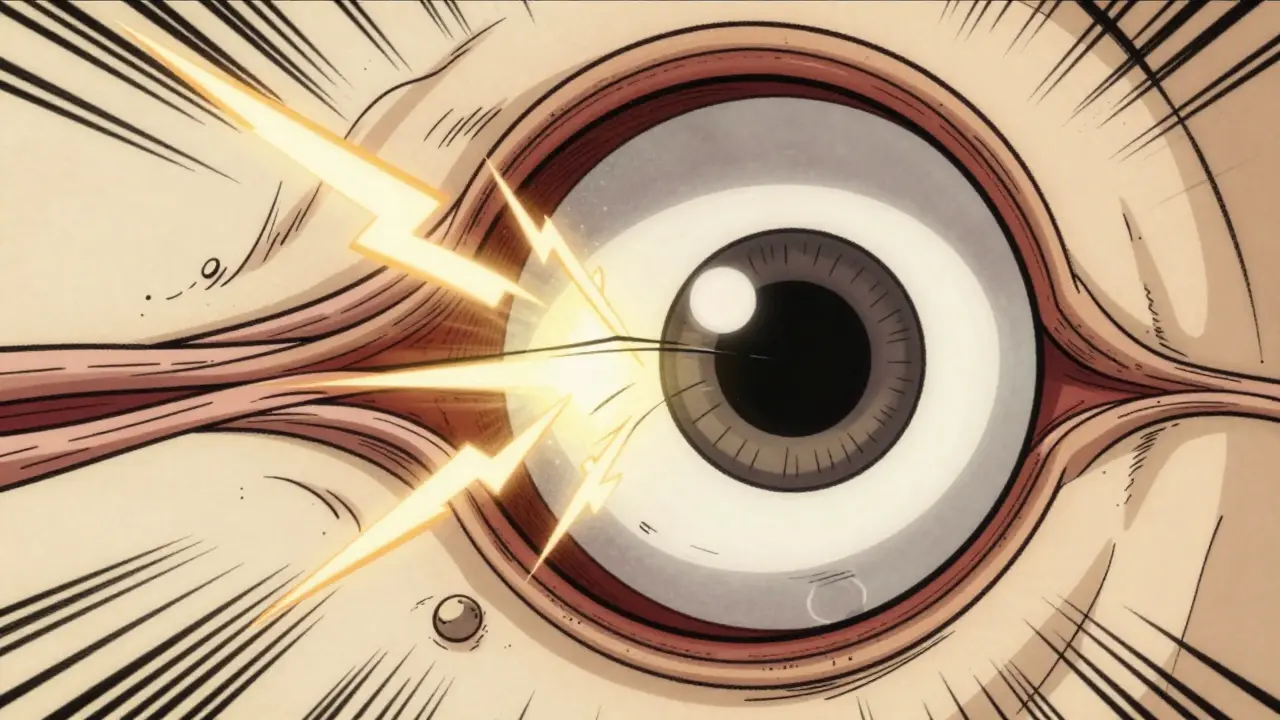
Floaters are shadows cast by tiny clumps of gel or cells inside the vitreous, the clear, jelly-like substance that fills the back of your eye. They look like specks, threads, or spiderwebs that move when you move your eyes. They’re most noticeable against bright backgrounds - like a blue sky or a white screen. Flashes, on the other hand, are brief streaks or sparks of light you see without any actual light source. They happen when the vitreous tugs on the retina, the light-sensitive layer at the back of your eye. These aren’t diseases themselves. They’re symptoms. And the most common cause is something called posterior vitreous detachment (PVD). Around age 40, the vitreous starts to change. It’s made mostly of water, with a network of collagen fibers holding it together. Over time, those fibers break down. The gel begins to liquefy and shrink, pulling away from the retina. This is normal aging - and it happens to about 66% of people over 70.Why Do Floaters Get Worse With Age?
As the vitreous shrinks, it doesn’t just disappear - it leaves behind debris. These clumps of collagen float around in the liquid part of the vitreous. When light enters your eye, they cast shadows on your retina. That’s what you see as floaters. The more the vitreous pulls away, the more debris you get. That’s why people often notice a sudden shower of new floaters - not one or two, but dozens - when PVD starts. Flashes happen because the shrinking vitreous tugs on the retina. Your retina doesn’t “see” light the way your eyes do - it sends signals to your brain when it’s stimulated. When the vitreous pulls on it, your brain interprets that as a flash of light. It’s like tapping your eyelid and seeing stars - except it’s happening inside your eye.When Is It Just Aging - And When Is It an Emergency?
Most of the time, floaters and flashes are harmless. They’re annoying, sure. But they usually settle down over six months. Your brain learns to ignore them. The floaters may sink out of your central vision, and the flashes fade. But here’s the critical difference: if you suddenly get a lot of new floaters - especially if they come with flashes - that’s not normal. It could mean the vitreous pulled so hard on the retina that it tore it. A retinal tear is serious. If fluid leaks through the tear, it can lift the retina off the back of your eye. That’s a retinal detachment. And if it’s not treated within days, you can lose vision permanently. The signs you can’t ignore:- Sudden increase in floaters - like a handful of black dots or a cloud appearing
- Flashes that keep happening, especially in clusters
- A dark curtain or shadow creeping across your vision
- Loss of side vision - like your peripheral sight is being blocked
Who’s at Higher Risk?
Not everyone develops PVD at the same time. Some people are more likely to have it earlier - and with complications.- People who are nearsighted: Their eyes are longer than average, which puts more stress on the vitreous. They often get PVD 10 to 15 years earlier than others.
- People with diabetes: High blood sugar can damage blood vessels in the eye. If those vessels bleed into the vitreous, it causes new floaters - and increases the risk of retinal tears.
- People who’ve had eye surgery: Cataract surgery, for example, can speed up vitreous changes.
- People over 50: The older you are, the more likely PVD is happening. By 65, about 75% of people have experienced it.
What Happens at the Eye Doctor?
Your optometrist or ophthalmologist won’t just look at your eyes - they’ll dilate your pupils. That lets them see the back of your eye clearly. They’ll check for:- Retinal tears or holes
- Signs of bleeding in the vitreous
- Detachment of the retina
- Other conditions like diabetic eye disease

Can You Treat Floaters?
Most doctors won’t treat simple floaters. Why? Because the risks of treatment often outweigh the benefits. There’s a procedure called laser vitreolysis - where a laser breaks up large floaters. But it’s not widely covered by insurance, and it doesn’t work for everyone. It also carries a small risk of damaging the retina. Surgery - called a vitrectomy - removes the vitreous and replaces it with fluid. But it’s only done in extreme cases, like when there’s heavy bleeding or a retinal detachment. It’s invasive, carries risks of infection or cataracts, and isn’t recommended just for bothersome floaters. For most people, the best treatment is time. Your brain adapts. The floaters settle lower in your eye. You learn not to notice them. It usually takes 3 to 6 months. Some people say it takes up to a year. But they almost always get better.What Should You Do Right Now?
If you’ve had floaters for years and they’re stable - no new changes - you’re likely fine. Keep your regular eye exams. But if you’re experiencing any of these:- Sudden new floaters
- Flashes that keep happening
- A shadow or curtain in your vision
Can You Prevent Floaters and Flashes?
No. PVD is a natural part of aging. You can’t stop it. But you can reduce your risk of complications:- Control your blood sugar if you have diabetes
- Manage your blood pressure
- Wear protective eyewear during sports or DIY projects
- Don’t ignore eye trauma - even minor injuries can trigger vitreous changes
Are floaters and flashes always a sign of something serious?
No. Most floaters and flashes are caused by posterior vitreous detachment (PVD), a normal part of aging that affects about 75% of people over 65. They’re usually harmless and become less noticeable over time. But sudden increases in floaters, especially with flashes or vision loss, can signal a retinal tear or detachment - which requires urgent care.
How long do floaters last?
Floaters from PVD typically become less noticeable within 3 to 6 months as the brain learns to ignore them and the debris settles lower in the eye. Some people may still notice them occasionally for a year or longer, but they rarely interfere with daily life. If floaters suddenly worsen after months of stability, see your eye doctor.
Can floaters cause blindness?
Floaters themselves don’t cause blindness. But they can be a warning sign of a retinal tear or detachment - conditions that can lead to permanent vision loss if untreated. That’s why sudden changes in floaters or flashes must be evaluated immediately by an eye specialist.
Should I go to the ER for floaters and flashes?
Yes - if you experience a sudden shower of new floaters, persistent flashes, or a dark curtain over your vision. These are signs of possible retinal detachment. Go to an emergency eye clinic or hospital eye department the same day. Delaying treatment increases the risk of permanent vision loss.
Do I need glasses to fix floaters?
No. Glasses correct focusing problems like nearsightedness or astigmatism, but they can’t remove or reduce floaters. Floaters are inside the eye, not on the surface. The only way to address them is through observation, laser treatment (rarely), or surgery (only in extreme cases).
Can stress or screen time cause floaters?
No. Stress and screen time don’t cause floaters. They may make you more aware of them - especially if your eyes are tired - but the cause is physical changes inside the vitreous gel. Floaters are related to aging, eye shape, or injury - not digital eye strain.





Dan Padgett
December 16, 2025 AT 04:40Seen a few floaters lately, and honestly? I thought I was going crazy. Then I read this and realized I’m not alone. It’s weird how your body changes without warning - like your eyes just decided to start showing you ghosts. But now I know: if it’s sudden, don’t ignore it. I’m booking an appointment tomorrow.
Kayleigh Campbell
December 17, 2025 AT 14:18So let me get this straight - my brain is just *learning to ignore* the little space spiders in my eyeballs? Cool. I’ll just sit here, sipping my coffee, pretending I don’t see them. 🤷♀️
Kim Hines
December 19, 2025 AT 05:12I’ve had floaters since my 30s. Never told anyone. Thought it was just me. This post made me feel less weird. Thanks.
Cassandra Collins
December 21, 2025 AT 00:24Wait… what if this is all a lie? What if the government put those floaters in our eyes to distract us from the 5G implants? I’ve been seeing flashes since my phone got upgraded. Coincidence? I think not. 🕵️♀️
Joanna Ebizie
December 21, 2025 AT 21:47People still don’t go to the doctor for this? Bro. You’re not a vampire. Your eyes aren’t haunted. Get checked before you lose your vision and blame the internet.
Mike Smith
December 23, 2025 AT 08:34Thank you for this clear, compassionate, and critically important guide. Many individuals dismiss these symptoms out of fear, ignorance, or the false belief that aging means enduring discomfort. This is not merely medical advice - it is a lifeline. Please share it widely. Vision is irreplaceable, and early detection saves more than sight - it saves dignity, independence, and peace of mind.
SHAMSHEER SHAIKH
December 23, 2025 AT 13:34As a medical professional with over two decades of clinical experience, I must emphasize: the posterior vitreous detachment is, indeed, a physiological inevitability - yet, the abrupt onset of photopsia and a significant increase in floater density are red flags that demand immediate ophthalmological evaluation. Delaying care, even for 48 hours, may result in irreversible retinal detachment, which carries a 30% to 50% risk of permanent visual impairment if not surgically addressed within the critical window. I urge all patients, particularly those over 50 or with myopia, to undergo a dilated fundoscopic examination at the first sign of change - not convenience, not tomorrow, but today.
Elizabeth Bauman
December 24, 2025 AT 17:12My grandmother had floaters. She lived to 94. She never saw a doctor. She just blinked and moved on. America’s medical system is out of control - you don’t need a $300 eye exam to live your life. If your vision doesn’t go black, you’re fine. Stop being scared by clickbait.
Dylan Smith
December 24, 2025 AT 22:57I'm 42 and got a bunch of floaters last week. I'm diabetic so I'm already nervous. I didn't know they could be linked to PVD. I'm going to the clinic next week. I hope it's nothing. But I'm glad I read this. I didn't even know what to Google before.
Arun ana
December 25, 2025 AT 19:31Floaters are just nature’s way of reminding us we’re not immortal 😅
Aditya Kumar
December 26, 2025 AT 00:09Meh.