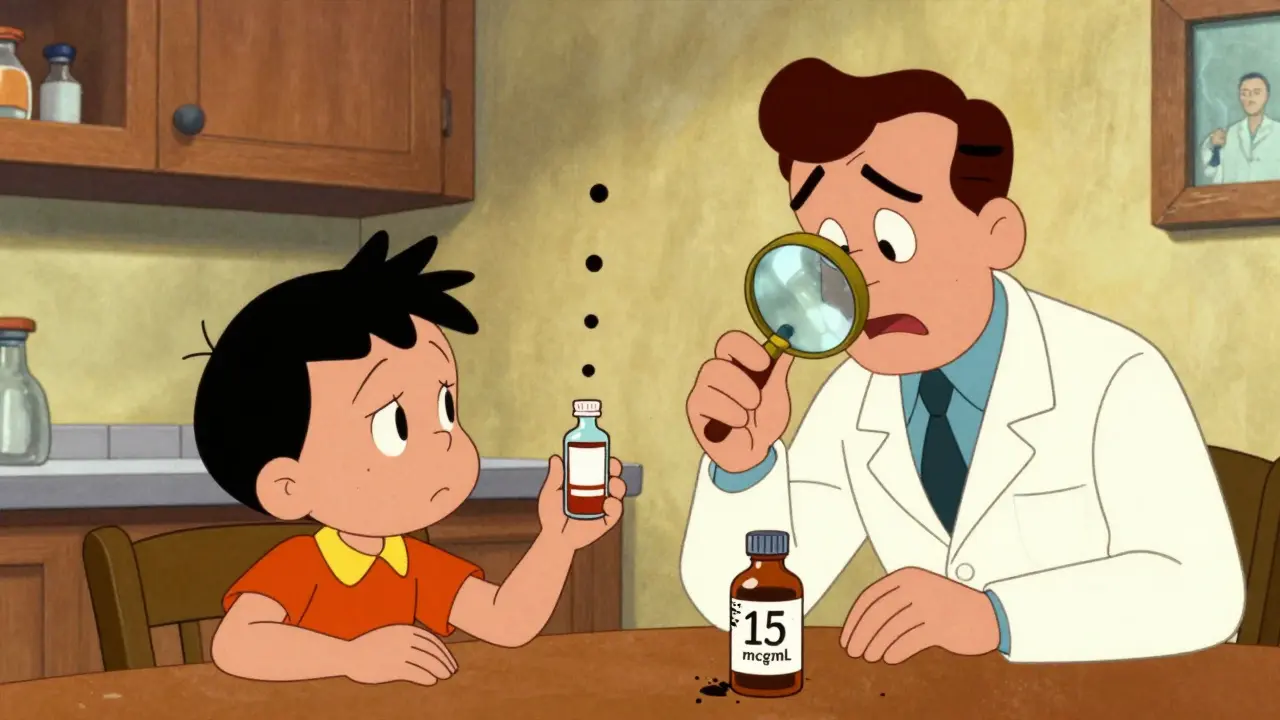
When your child can’t swallow a pill, or the medicine tastes so bitter they gag, it’s tempting to turn to a compounded medication. These custom-made drugs are mixed by pharmacists to fit a child’s exact needs-whether it’s a sugar-free liquid for a diabetic kid, a flavor-free version for a sensitive palate, or a tiny dose of a powerful drug like morphine for a newborn. But here’s the hard truth: compounded medications aren’t FDA-approved. That means no one checked if they’re safe, strong enough, or even clean. And for kids, that gap can be deadly.
Why Compounded Medications Are Used for Children
Commercial drugs are made for adults. Kids aren’t just small adults-they have different body weights, metabolisms, and sensitivities. That’s why pharmacists sometimes make custom versions:
- Flavoring bitter drugs like antibiotics so kids will take them
- Removing dyes or alcohol that trigger allergic reactions
- Creating sugar-free formulas for children with diabetes
- Diluting adult doses into tiny amounts for babies in the NICU
- Removing preservatives like benzyl alcohol, which can harm newborns
The National Academy of Medicine confirmed in May 2025 that these needs are real. But they also warned: “The increased production and use of compounded medication could pose a significant threat to the health and well-being of patients.” Especially kids.
The Hidden Dangers in Every Drop
Imagine this: A pharmacy mixes a liquid version of levothyroxine for an 8-year-old. The prescription says 25 mcg/mL. But the pharmacist misreads the decimal. The final mix ends up at 15 mcg/mL-40% weaker than it should be. The child’s thyroid levels crash. They get tired, cold, and sluggish. Two weeks later, they end up in the ER. This isn’t fiction. It happened. A parent posted it on Reddit in January 2025. The child survived. Others haven’t.
According to the Institute for Safe Medication Practices (ISMP), 14-31% of pediatric medication errors involve compounded drugs. Most are dosing mistakes. Why? Because:
- Concentrations aren’t clearly labeled
- Pharmacists skip double-checks
- Parents aren’t told how to measure the dose
- Equipment like syringes or measuring cups isn’t calibrated
SafeMedicationUse.ca found that 68% of errors come from confusion over units-like confusing milligrams with micrograms, or not knowing if a liquid is 5 mg/mL or 50 mg/mL. One wrong decimal point can mean a 10x overdose.
When Compounded Drugs Are Not the Answer
The FDA says this clearly: “Unnecessary use of compounded drugs may expose patients to potentially serious health risks.” So if there’s an FDA-approved alternative, use it.
For example:
- Instead of compounding IV antibiotics, use premixed, sterile, unit-dose syringes made by manufacturers
- Use pre-flavored, pre-measured oral suspensions instead of custom mixes
- Choose FDA-approved chewable tablets over liquid compounding when possible
Compounded sterile products-like IV bags or injections-are especially risky. The 2012 fungal meningitis outbreak killed 64 people after contaminated spinal injections were given. The source? A compounding pharmacy. That’s not rare. The FDA’s Adverse Event Reporting System recorded over 900 incidents linked to compounded semaglutide and tirzepatide by the end of 2024, including 17 deaths. Pediatric patients were disproportionately affected by vomiting, nausea, and acute pancreatitis.
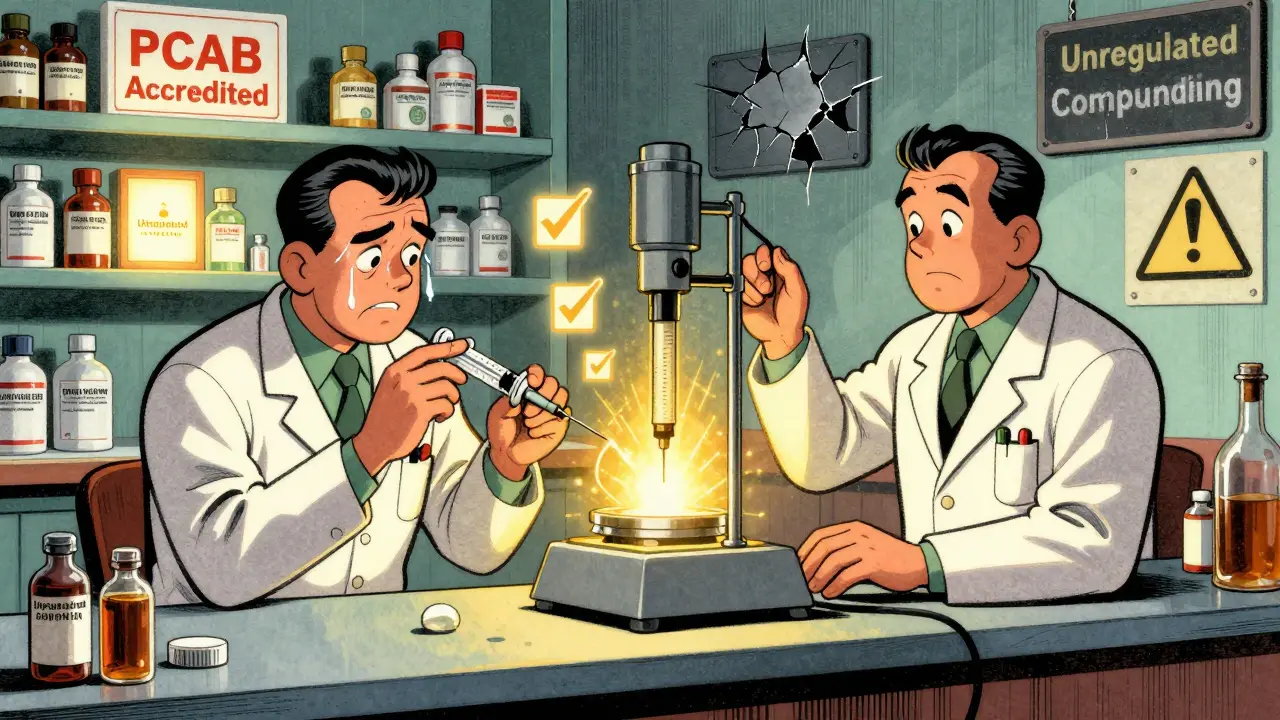
How to Spot a Safe Compounding Pharmacy
Not all pharmacies are equal. Some follow strict rules. Others cut corners. Here’s how to tell the difference:
- Check for PCAB or NABP accreditation. The Pharmacy Compounding Accreditation Board (PCAB) and the National Association of Boards of Pharmacy (NABP) are the only two groups that audit compounding pharmacies for safety. If the pharmacy doesn’t display their accreditation on their website or in the office, walk away.
- Ask if they use gravimetric analysis. This is a high-tech weighing system that measures ingredients by mass, not volume. It’s far more accurate than eyeballing liquids with syringes. Only 7.7% of U.S. hospitals use it-mostly because it costs $25,000-$50,000 per station. But if a pharmacy serving kids doesn’t use it, they’re taking a gamble with your child’s life.
- Verify state licensing. All compounding pharmacies must be licensed by their state’s pharmacy board. You can check this online through your state’s board of pharmacy website.
- Ask about their training. Pharmacists who compound for kids should have completed at least 40 hours of specialized pediatric dosing training. Ask if their technicians are certified in USP Chapter <797> standards for sterile compounding.
Out of 7,200 compounding pharmacies in the U.S., only 1,400 hold PCAB accreditation. That’s less than 20%. Don’t settle for less.
What Parents Must Do Before Giving the Medicine
You’re the last line of defense. No one else will double-check for you. Here’s your checklist:
- Ask for the exact concentration. Don’t accept “it’s the same as the pill.” Ask: “What is the strength in mg/mL or mcg/mL?” Write it down.
- Confirm the dose with both the doctor and pharmacist. If the doctor says 0.5 mL twice a day, and the pharmacist says 1 mL, stop. Call the doctor back. Discrepancies happen. They’re not always mistakes-but they need to be cleared.
- Use the right measuring tool. Never use a kitchen spoon. Use a calibrated oral syringe or dosing cup provided by the pharmacy. If they didn’t give you one, ask for it.
- Check the color and smell. If the liquid looks cloudy, has particles, or smells weird-don’t give it. Call the pharmacy immediately.
- Store it correctly. Some compounded meds need refrigeration. Others must be used within 7 days. Ask for storage instructions in writing.
- Watch for side effects. Vomiting, lethargy, rash, or unusual sleepiness? Call the doctor. Don’t wait. These could be signs of under- or over-dosing.
The Tragedy That Changed Everything
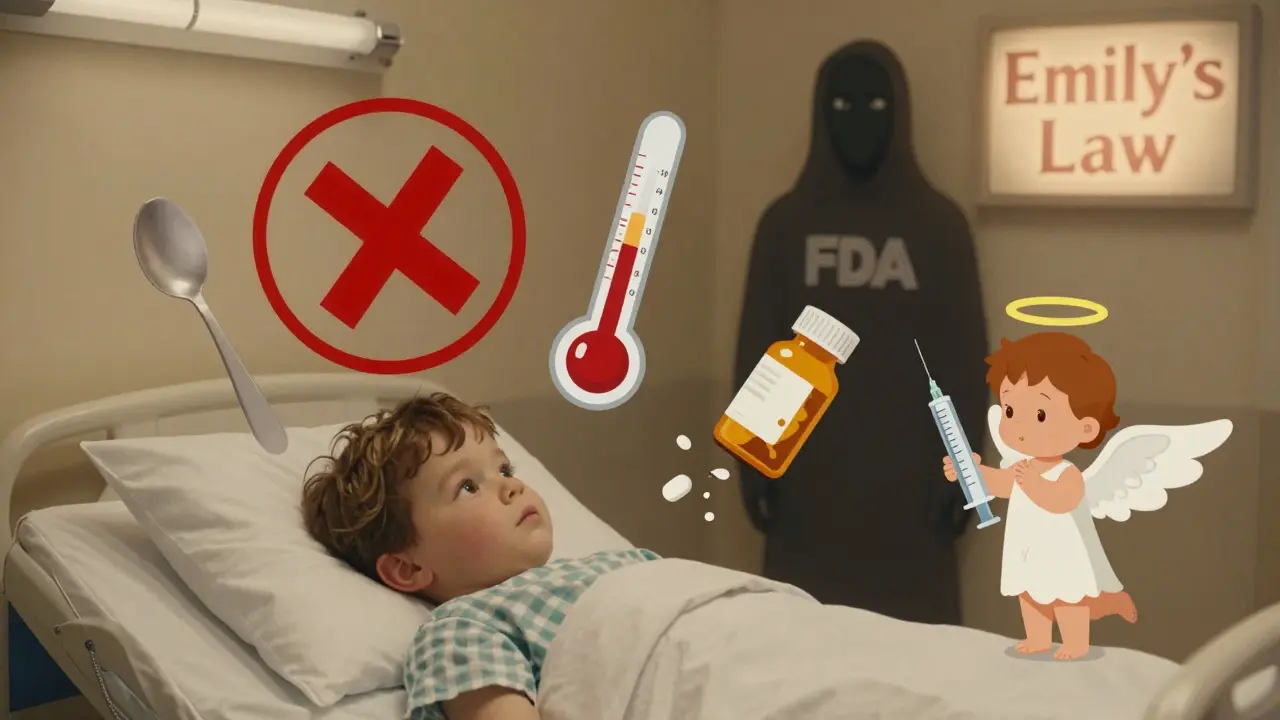
In 2006, two-year-old Emily Jerry died from a compounded chemotherapy dose that was 10 times too strong. The error? A pharmacist misread a decimal. The equipment? A manual syringe. The fix? Gravimetric analysis. It was already available. But no one required it.
Her father, Dr. Jerry, founded the Emily Jerry Foundation. Since then, 28 states have introduced “Emily’s Law” bills requiring gravimetric verification for all pediatric compounded sterile preparations. The FDA, ISMP, and ASHP all agree: this isn’t optional anymore. It’s a standard of care.
And yet, most pharmacies still don’t use it. Why? Cost. Training. Time. But for a child, those are not reasons. They’re risks.
What’s Coming Next
The compounded drug market hit $11.3 billion in 2024, growing at 12.7% a year. Pediatric compounding makes up only 8.2% of that-but it’s the most dangerous segment. The FDA is cracking down. In May 2025, they warned that some pharmacies are still making compounded versions of drugs long after shortages ended. That’s illegal. But enforcement is slow.
ISMP is developing pediatric-specific safety metrics for 2025. Hospitals that use gravimetric systems report a 75% drop in dosing errors. But without mandates, adoption will stay low.
The future of pediatric compounding isn’t about more drugs. It’s about better safety. Technology. Training. Transparency. And parents who refuse to accept anything less.
When to Say No
If your child’s doctor prescribes a compounded medication, ask: “Is there an FDA-approved version?” If the answer is yes-push for it. If the answer is no, ask: “Why not?” If they say, “It’s the only way,” ask: “What safety steps are you taking to make sure this is accurate?”
Compounded medications can save lives. But they can also end them. The difference isn’t luck. It’s vigilance.
Are compounded medications FDA-approved?
No. Compounded medications are not FDA-approved. The FDA does not review them for safety, effectiveness, or quality before they’re given to patients. This is why it’s critical to use only accredited pharmacies and verify every detail of the prescription.
Can I give my child a compounded medication without checking the dose?
Never. Dosing errors are the most common cause of harm with compounded medications. Always confirm the concentration (e.g., mg/mL) with both the prescriber and pharmacist. Use only the measuring tool they provide. A kitchen spoon or unmarked syringe can lead to a fatal overdose or underdose.
What’s the safest way to give a compounded liquid to a child?
Use a calibrated oral syringe provided by the pharmacy. Never use household spoons or unmarked containers. Store the medication exactly as instructed-some need refrigeration, others must be used within 7 days. Always check for changes in color, smell, or texture before each use.
How do I know if the pharmacy is trustworthy?
Look for PCAB or NABP accreditation. These are the only independent standards for compounding safety. Ask if they use gravimetric analysis (a precision weighing system) for pediatric doses. Check their state license online. If they can’t answer these questions clearly, find another pharmacy.
Why do some doctors prescribe compounded drugs instead of regular ones?
Often because a child has an allergy, can’t swallow pills, or needs a dose that isn’t commercially available. But doctors should always check if an FDA-approved alternative exists first. If they don’t, ask why. The goal is to use the safest, most reliable option-not just the most convenient one.
What should I do if my child has a bad reaction to a compounded medication?
Stop giving the medication immediately. Call your child’s doctor and the pharmacy. Save the bottle, syringe, and any packaging. Report the reaction to the FDA’s MedWatch program. You can file a report online at fda.gov/medwatch. This helps track dangerous products and protect other families.


Laura Gabel
March 20, 2026 AT 05:32Jeremy Van Veelen
March 21, 2026 AT 20:29Kyle Young
March 22, 2026 AT 08:48Kendrick Heyward
March 22, 2026 AT 23:57lawanna major
March 24, 2026 AT 22:44Ayan Khan
March 25, 2026 AT 13:42Emily Hager
March 26, 2026 AT 17:57Melissa Starks
March 28, 2026 AT 04:42Lauren Volpi
March 29, 2026 AT 20:44