
Every year, over a million kids in the U.S. end up in the emergency room because of mistakes with over-the-counter (OTC) medicines. Most of these errors happen because parents give the wrong dose - not because they’re careless, but because the labels are confusing. You’re not alone if you’ve stared at a tiny bottle, wondering whether to give 5 mL or 7.5 mL. The good news? Reading these labels correctly is simple once you know what to look for. And it’s not about guessing your child’s age - it’s about their weight.
Why Weight Matters More Than Age
You’ve probably seen those age-based dosing charts on medicine bottles: "For children 2-3 years: 5 mL." But here’s the truth: those numbers are just a rough guide. The real key to safety is your child’s weight. A 2-year-old who weighs 30 pounds needs a different dose than a 2-year-old who weighs 18 pounds. Age doesn’t tell you how much medicine their body can handle - weight does.The American Academy of Pediatrics (AAP) says using age instead of weight leads to dosing errors in 23% of cases. That’s more than 1 in 5 times. Underdosing means the medicine won’t work. Overdosing? That’s when things get dangerous. Acetaminophen, the active ingredient in Tylenol, is the leading cause of accidental liver failure in kids. One extra teaspoon can push a child into toxicity.
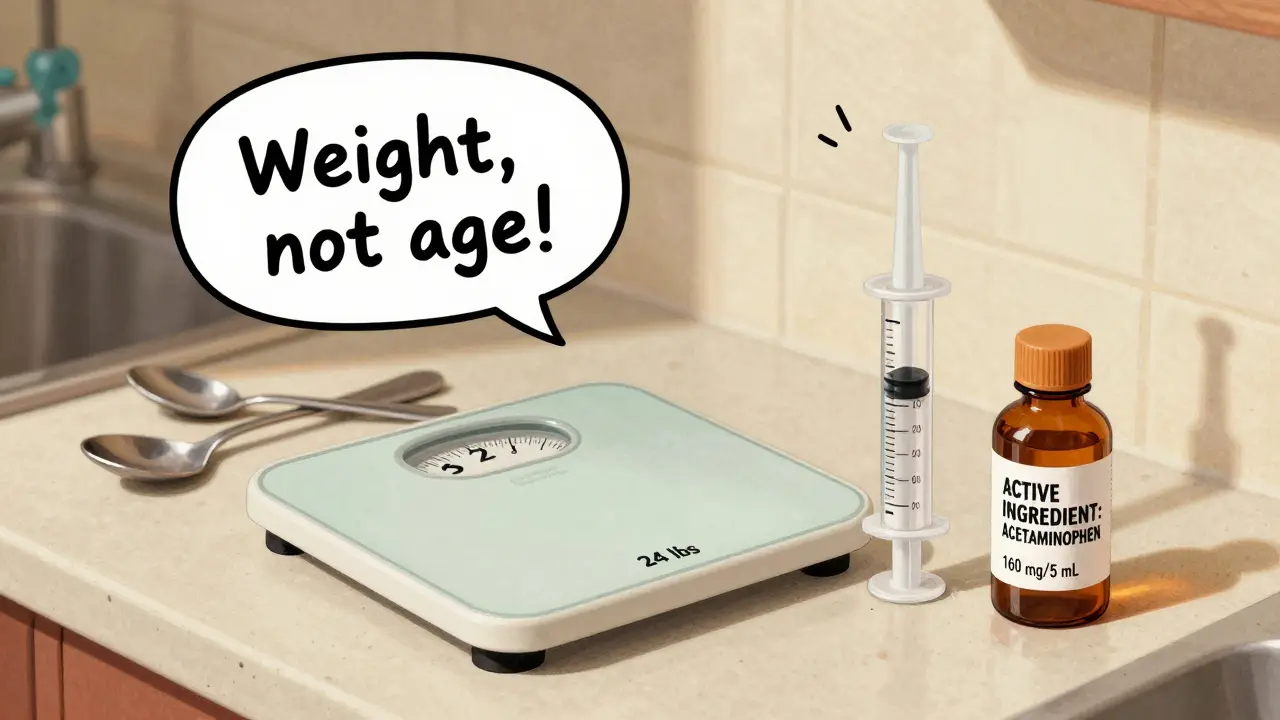
Doctors and pharmacists agree: if you know your child’s weight, use that. If you don’t, use age - but get their weight checked at the next doctor’s visit. Don’t guess. Don’t estimate. Weigh them. A simple bathroom scale works. Just hold your child and step on, then subtract your weight. That’s the number you need.
What to Look for on the Label
OTC children’s medicine labels have changed a lot since 2011, thanks to FDA rules. Before then, there were different concentrations of acetaminophen - infant drops, children’s liquid, even chewables with different strengths. Parents mixed them up. Kids got too much. Now, everything is standardized.Here’s what every label must show:
- Active ingredient: Acetaminophen or ibuprofen. Always check this. Some cold medicines also contain acetaminophen - never mix them.
- Strength: "160 mg per 5 mL" for children’s acetaminophen. For ibuprofen, it’s "100 mg per 5 mL." This is critical. If you see "80 mg per 0.8 mL," that’s infant drops - a different formula.
- Weight-based dosing chart: Look for pounds and kilograms. Typical ranges are 12-17 lbs, 18-23 lbs, 24-35 lbs, and so on up to 96+ lbs.
- Age warning: "Do not use for children under 6 months" for ibuprofen. "Do not use for children under 2 years" for Benadryl unless directed by a doctor.
- Dosing frequency: Acetaminophen: every 4 hours, max 5 doses in 24 hours. Ibuprofen: every 6-8 hours, max 4 doses in 24 hours.
- Maximum daily dose: Usually printed as "Do not exceed 5 doses in 24 hours" or "Do not give more than 4 doses in 24 hours."
- Warning: "Do not use with other medicines containing acetaminophen." This is a big one. Many cold and flu products have it too.
Look for the word "mL" - milliliters. That’s the only unit you should use. Never trust a kitchen spoon. A teaspoon from your drawer might hold 6 mL, 7 mL, or even 9 mL. Medical syringes and dosing cups are made to be exact. Keep one in your medicine cabinet - and never let it get lost in the junk drawer.
Acetaminophen vs. Ibuprofen: Key Differences
These two common medicines work differently. Mixing them up can be risky.Acetaminophen (Tylenol):
- Strength: 160 mg per 5 mL
- Dose for 24-35 lbs: 5 mL
- How often: Every 4 hours
- Max per day: 5 doses
- Can be used from 2 months old (with doctor’s advice)
Ibuprofen (Advil, Motrin):
- Strength: 100 mg per 5 mL
- Dose for 24-35 lbs: 5 mL
- How often: Every 6-8 hours
- Max per day: 4 doses
- Not for infants under 6 months - ever
Notice something? For a child weighing 24-35 pounds, both medicines use 5 mL. But the active ingredient is different. Acetaminophen has 160 mg per 5 mL. Ibuprofen has 100 mg per 5 mL. So even though the volume is the same, the medicine is not. That’s why reading the active ingredient matters.
Also, ibuprofen can’t be given to babies under 6 months. Acetaminophen can - but only if your pediatrician says so. Never assume. Always check the label and call your doctor if your child is under 3 months and has a fever.
What to Do When Your Child’s Weight Falls Between Ranges
Your child weighs 21 pounds. The chart says 18-23 lbs: 5 mL. Perfect. But what if they weigh 25 pounds? The chart says 24-35 lbs: 5 mL. Same dose? Yes - because the range is designed to cover a safe window.But here’s the rule: Always round down if your child’s weight is between two categories. For example, if your child weighs 36.5 pounds and the chart lists 36-47 lbs as 7.5 mL and 48-59 lbs as 10 mL, use 7.5 mL. Why? Because it’s safer. Underdosing is rarely dangerous. Overdosing can be life-threatening.
Some parents think, "My child is big for their age - they need more." But medicine isn’t about size - it’s about metabolism. A heavier child doesn’t need more just because they’re tall. The chart is built on scientific dosing studies. Stick to it.
Common Mistakes Parents Make (And How to Avoid Them)
Even with clear labels, mistakes still happen. Here are the top three:- Using kitchen spoons. A tablespoon is 15 mL. A teaspoon is 5 mL. But your kitchen spoon? It might hold 7 mL. One parent told me they gave their toddler 15 mL thinking it was 5 mL because they used a "teaspoon" from the drawer. Result? ER visit. Use the syringe that came with the bottle.
- Double-dosing with cold medicine. Tylenol Cold + Flu has acetaminophen. So does Children’s Tylenol. Giving both? You’re giving double the acetaminophen. That’s how liver damage starts. Always check the "Active Ingredients" section on every bottle.
- Confusing infant drops with children’s liquid. Infant drops are concentrated: 80 mg per 0.8 mL. Children’s liquid is 160 mg per 5 mL. If you use the wrong syringe or misread the concentration, you could give 5 times too much. Always check the strength and use the right tool.
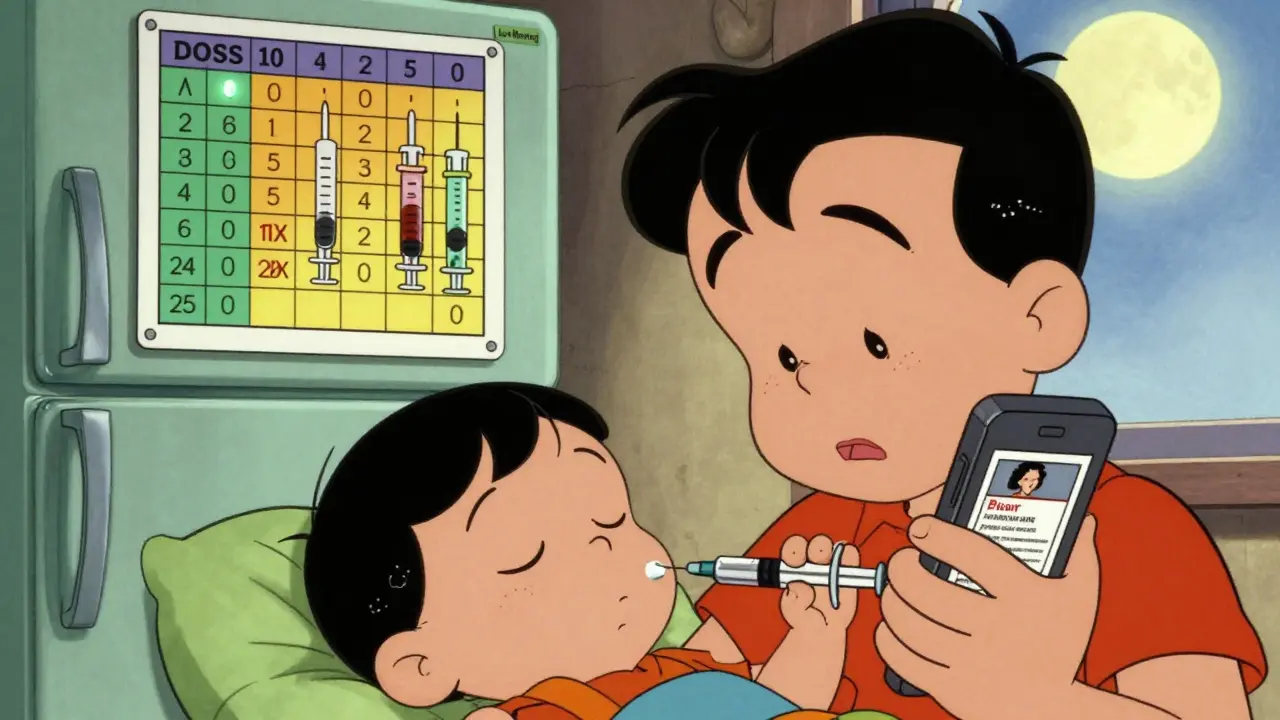
Pro tip: Take a photo of the dosing chart on the label when you buy it. Put it in your phone. That way, when your child wakes up at 3 a.m. with a fever, you’re not fumbling with the bottle in the dark.
What About Benadryl and Other OTC Products?
Benadryl (diphenhydramine) is another common mistake. It’s not meant for everyday colds. It’s for allergies. And it’s not safe for kids under 2 unless a doctor says so. Why? It can cause dangerous drowsiness, breathing trouble, or even seizures in young children.Also, Benadryl comes in different strengths:
- Liquid: 12.5 mg per 5 mL
- Tablets: 25 mg each
That means if you give a 2-year-old a tablet thinking it’s the same as the liquid, you’re giving them double the dose. Always read the label. Never assume.
Other products like cough syrups, teething gels, and nasal sprays also have hidden ingredients. Some contain antihistamines, decongestants, or alcohol. These aren’t meant for kids under 6. The label will say so. Read it.
Tools to Help You Get It Right
You don’t have to memorize charts. There are tools to make this easier:- Dosing syringes: Buy one with mL markings. Keep it with the medicine. They’re cheap - under $5 at any pharmacy.
- Digital dosing calculators: Websites like HealthyChildren.org and OU Health have free tools. Enter your child’s weight, pick the medicine, and it tells you the exact dose.
- Color-coded charts: Some hospitals, like St. Louis Children’s Hospital, have printed charts with pictures of syringes filled to the right level. Print one and tape it to your fridge.
And here’s a trick: write the dose on the syringe with a permanent marker. "5 mL for 24-35 lbs." That way, even if you’re tired or stressed, you can’t misread it.
What’s Changing in 2025?
The FDA is pushing for even clearer labels. By 2025, most children’s OTC medicines will have QR codes that link to short video instructions. Some will show the syringe filling in real time. Others will include "syringe units" - tiny marks for 0.2 mL increments - alongside mL numbers.Why? Because even with standardization, 35% of parents still get confused by mL. One study found that people thought "mL" meant "cubic centimeters" - which is technically the same, but they didn’t know that. Visual aids help.
Also, all acetaminophen labels now must say "Liver Warning" in bold for kids under 12. That’s new since early 2024. It’s there because 47 children developed acute liver failure in 2023 from accidental overdoses. That’s 47 too many.
Final Checklist Before Giving Any Medicine
Before you give any OTC medicine to your child, run through this quick list:- Do I know my child’s weight? If not, use age - but get their weight soon.
- Is this the right medicine? Check the active ingredient.
- What’s the concentration? 160 mg/5mL for acetaminophen? 100 mg/5mL for ibuprofen?
- What’s the dose for their weight? Use the chart, not age.
- Am I using the right tool? Syringe or dosing cup - never a spoon.
- Is this medicine already in another product I’m giving? Check for acetaminophen in cold meds.
- Am I giving it too often? Acetaminophen: max 5 times in 24 hours. Ibuprofen: max 4 times.
- Is my child under 6 months? If yes, don’t give ibuprofen. Call your doctor before giving acetaminophen.
If you’re unsure? Call your pediatrician. Or go to a pharmacy. A pharmacist will help you for free. No judgment. No rush. Better safe than sorry.
Can I use a kitchen spoon if I don’t have a dosing syringe?
No. Kitchen spoons vary in size - they can hold 4 mL to 9 mL, even if labeled "teaspoon." A standard teaspoon holds about 5 mL, but many hold more. Giving too much medicine can be dangerous. Always use the syringe or dosing cup that came with the bottle.
What if my child weighs less than 12 pounds?
If your child is under 12 pounds (about 5.5 kg), do not give any OTC medicine without talking to your pediatrician first. Dosing for very small infants requires precise calculations based on weight in kilograms and medical history. Never guess.
Is it safe to give acetaminophen and ibuprofen together?
Yes - but only if you follow the schedule carefully. You can alternate them every 3 hours (e.g., acetaminophen at 12 p.m., ibuprofen at 3 p.m., acetaminophen at 6 p.m.). Never give both at the same time. Always write down what you gave and when to avoid doubling up.
Why do some labels say "for children 2 years and up" but others say "2 months and up"?
It depends on the medicine. Acetaminophen can be used as early as 2 months with a doctor’s approval. Ibuprofen is not approved for children under 6 months. Benadryl is not approved for children under 2 years. Always check the specific label - don’t assume all medicines follow the same rules.
What should I do if I think I gave my child too much medicine?
Call Poison Control immediately at 1-800-222-1222 (U.S.) or your local emergency number. Do not wait for symptoms. Even if your child seems fine, overdose can damage the liver or kidneys hours later. Keep the medicine bottle handy - you’ll need the concentration and amount given.
Next Steps: Stay Safe, Stay Informed
Reading medicine labels isn’t about being a pharmacist. It’s about being a careful parent. The system is designed to help you - if you know how to use it. Weigh your child. Use the syringe. Check the active ingredient. Don’t mix medicines. And when in doubt, call your doctor.Medicine errors are preventable. You don’t need to be perfect. You just need to be informed. And now, you are.


Justin James
December 24, 2025 AT 15:50Okay but have you seen the new FDA 2025 QR code thing? They’re embedding microchips in the bottle caps now-don’t laugh. I read a whistleblower report that says the same companies pushing these ‘standardized labels’ also own the patent on the dosing syringes. They’re monetizing your fear. Every time you buy a new syringe because you lost the last one, they make a profit. And the ‘color-coded charts’? Printed on recycled paper from the same plant that makes the medicine bottles. It’s all one big loop. You think you’re safe? You’re just feeding the machine. I weighed my kid last week. 34 lbs. Gave him 5 mL. Then I checked the batch number on the bottle. It was from the same run as the 2023 liver failure cases. I threw it out. Called my cousin who works at the CDC. He said they’re ‘reviewing.’ Reviewing? They’ve known this since 2011.
Zabihullah Saleh
December 26, 2025 AT 13:29It’s funny how we treat medicine like it’s a math problem when it’s really a relationship. Your child’s body isn’t a calculator. It’s a living thing that breathes, sleeps, cries, and reacts. Weight is a number. But trust? That’s the real dose. I’ve given Tylenol to my daughter since she was 4 months old. Never used a syringe. Just a clean spoon. Clean, not measured. I watched her. Watched her eyes. Watched her sleep. If she stirred too much? I held off. If she slept too deep? I called the doctor. The label says 160 mg per 5 mL. But what does that mean to a 17-pound soul? Nothing. What matters is the hand that holds it. The voice that says, ‘I’m here.’ The quiet moment before you give it. That’s the real medicine. The rest? Just noise.
Christopher King
December 27, 2025 AT 22:24THIS IS A GOVERNMENT SCAM. I’ve been tracking this since 2018. The FDA doesn’t care about your kid. They care about Big Pharma’s stock prices. You know why they standardized the concentrations? So you couldn’t tell the difference between infant drops and children’s liquid anymore. So you’d just grab the bottle and pour. So you’d accidentally overdose. So they could blame YOU. But I’ve got receipts. I’ve got the internal memos. I’ve got the email chain from 2021 where a Pfizer exec said, ‘The more parents panic, the more they buy our syringes and our apps.’ And now they’re adding QR codes? That’s not for safety-that’s for surveillance. Scan the code, and they know your kid’s weight, your location, your IP address, your Google search history. They’re building a pediatric pharmacological profile. And you’re just handing it over because you’re scared of a teaspoon. Wake up. The syringe is the trap.
Carlos Narvaez
December 28, 2025 AT 17:44Weight-based dosing is standard. Syringes > spoons. Active ingredient check is non-negotiable. Everything else is noise.
Rick Kimberly
December 30, 2025 AT 12:56I appreciate the thoroughness of this post. However, I would respectfully suggest that the emphasis on weight over age, while clinically sound, may inadvertently marginalize caregivers who lack access to accurate scales or regular pediatric visits. In many rural and low-income communities, parents rely on age-based guidelines not out of negligence, but out of necessity. Perhaps the solution isn’t just better labeling-but better access to tools, education, and healthcare infrastructure. A well-designed label is useless if the parent cannot weigh their child or afford a dosing syringe. The system must serve the most vulnerable, not just the informed.
Terry Free
December 30, 2025 AT 21:57Oh wow. A whole essay on not using a kitchen spoon. Congrats. You just won the Parenting Olympics. Meanwhile, my kid took Tylenol from my coffee spoon when I was changing a diaper. He’s 8. Alive. Healthy. Got an A in math. Maybe the real problem isn’t the label-it’s the panic culture that turns every fever into a thriller movie. You’re not a pharmacist. You’re a parent. Breathe. The kid’s not gonna die from 6 mL. Unless you gave him 60. Then yeah, call Poison Control. But 6? Nah. He’s fine. Go hug him.
sagar patel
December 31, 2025 AT 13:33Linda B.
January 1, 2026 AT 20:51So let me get this straight. The FDA says to use weight, but they don’t provide free scales. They say use a syringe, but don’t give them out for free. They say don’t mix meds, but let companies put acetaminophen in every cold syrup under 17 different names. And now you want me to feel guilty because I used a teaspoon? Please. This isn’t safety. This is performance. You’re not protecting kids-you’re policing mothers. I weighed my child. I used the syringe. I checked the label. And then I gave him the medicine anyway because I trusted my gut. And guess what? He’s fine. The real danger isn’t the dose. It’s the shame.