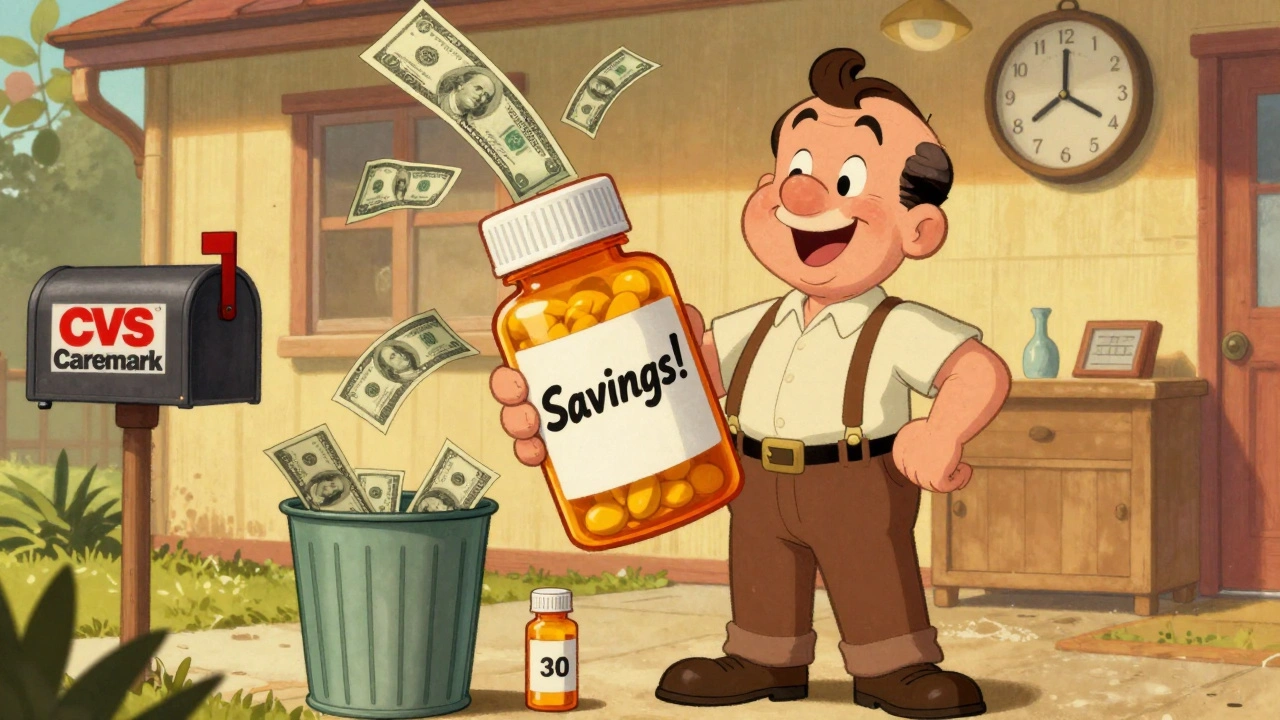
Getting your medication for 90 days instead of 30 isn’t just convenient-it can save you hundreds of dollars a year. If you take the same pills every month for high blood pressure, diabetes, cholesterol, or another long-term condition, you’re already paying the same copay three times over. Why not get three months’ worth at once and keep more money in your pocket?
Why 90-Day Fills Save Money
Most insurance plans charge the same copay whether you pick up a 30-day or 90-day supply. That means if your copay is $4.90 for a 30-day refill, you pay $4.90 for 90 days. That’s 60 extra days of medication-free. Over a year, that’s $39.20 saved on just one medication. Multiply that by three or four prescriptions, and you’re talking about $150 or more in annual savings.Some plans even offer lower copays for 90-day fills. Mail-order pharmacies like CVS Caremark or HPSM’s Postal Prescription Services often have the best deals because they’re built for bulk dispensing. Retail pharmacies like Walgreens or CVS now offer 90-day fills in-store too, so you don’t have to wait for mail delivery.
It’s not just about money. Fewer trips to the pharmacy mean less time off work, less gas, and less stress. You’re not scrambling to refill a prescription when you’re out. One study showed patients on 90-day fills make eight fewer pharmacy visits per year. That’s two months of your life back.
Who Qualifies for a 90-Day Prescription
Not every medication qualifies. Insurance companies and pharmacies only allow 90-day fills for chronic condition medications-the kind you take every day, long-term. Common examples include:- High blood pressure (lisinopril, amlodipine)
- Diabetes (metformin, glimepiride)
- Cholesterol (atorvastatin, rosuvastatin)
- Thyroid (levothyroxine)
- Depression or anxiety (sertraline, escitalopram)
You also need to have already been taking the medication successfully for at least a few months. Pharmacies won’t give you 90 days of a new drug unless your doctor confirms it’s working and safe for you.
Some drugs-like antibiotics, painkillers, or medications with strict dosing rules-are never eligible. Always check with your pharmacy or insurer first.
How to Get a 90-Day Prescription
There are two easy ways to get a 90-day supply:- Ask your doctor to write the prescription for 90 days instead of 30. This is the cleanest method. Just say: “I take this every day. Can you write it for a 90-day supply?” Most doctors are happy to do it-it improves adherence and reduces refill calls.
- Ask your pharmacy to fill your existing 30-day prescription for 90 days. If your prescription has refills left, many pharmacies will automatically give you 90 days if you ask. No new prescription needed.
Some insurers require prior authorization, especially for higher-cost drugs. Your pharmacy will handle that for you. If they say no, call your insurance provider directly. Sometimes a quick call clears it up.
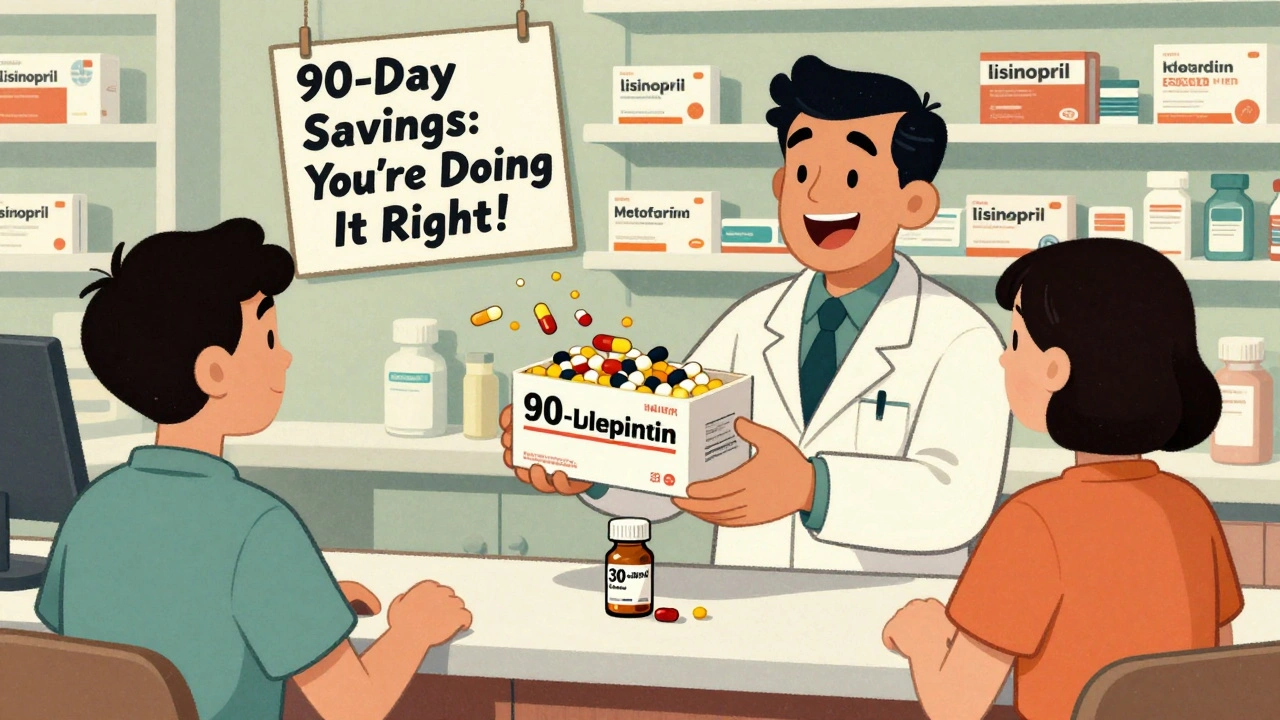
Mail-Order vs. Retail Pharmacy
You’ve got two main options for getting your 90-day supply:| Feature | Mail-Order Pharmacy | Retail Pharmacy |
|---|---|---|
| Cost | Usually lowest copay | Same or slightly higher than mail-order |
| Delivery | Free home delivery | Pick up in person |
| Speed | 7-10 days to receive | Same-day pickup |
| Convenience | Set up auto-refills | Need to remember to refill |
| Best for | Stable, long-term meds | Quick access, no waiting |
Mail-order services like CVS Caremark or HPSM’s PPSRX are ideal if you don’t mind waiting a week. They often have the lowest prices and auto-refill options so you never run out. Retail pharmacies are better if you need your meds fast or want to talk to a pharmacist in person.
How to Check Your Coverage
Before you ask for a 90-day fill, make sure your plan allows it. Here’s how:- Log into your insurance portal. Look for “prescription benefits” or “mail-order pharmacy.”
- Call the number on your insurance card. Ask: “Does my plan cover 90-day fills for [medication name]?”
- Ask your pharmacy to check. They can tell you the exact copay for a 90-day supply.
- Use GoodRx or SingleCare to compare prices. Sometimes the cash price at a retail store is cheaper than your insurance copay.
If your plan doesn’t cover 90-day fills for a specific drug, ask your doctor to switch to a similar medication that does. Sometimes switching to a generic version opens up the option.
Common Mistakes to Avoid
People often miss out on savings because of simple oversights:- Not asking. Many patients assume they can’t get 90 days unless told. Always ask.
- Assuming mail-order is the only way. Retail pharmacies now offer 90-day fills too.
- Ignoring copay differences. Some plans have lower copays for mail-order. Compare before choosing.
- Waiting until you’re out. Start the process when you still have 10-15 days left. Don’t risk running out.
- Not checking for manufacturer coupons. Some drugs like LINZESS offer $30 copays for 90-day fills-even if your insurance doesn’t cover it.
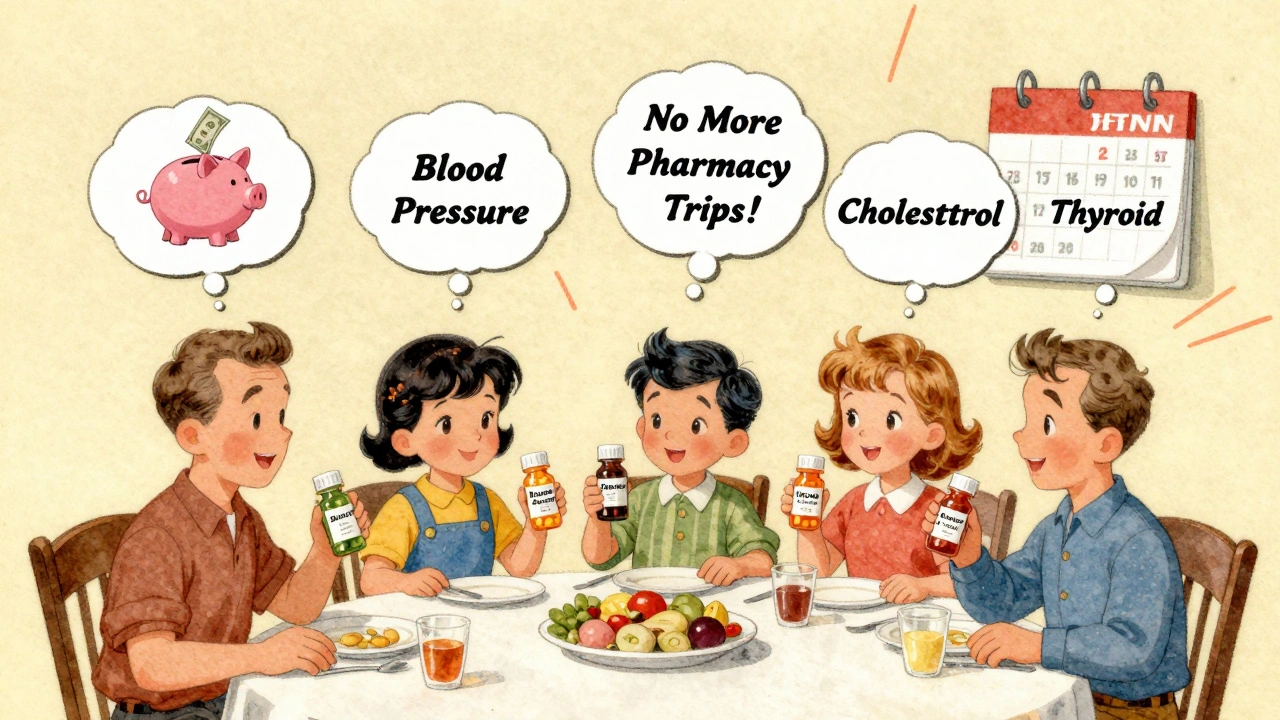
Real Savings, Real Impact
The numbers don’t lie. In 2025, Americans using home delivery for 90-day prescriptions saved $600 million across all insurance plans. If adoption doubled, that number could jump to $1.9 billion in one year alone.Doctors and researchers agree: longer fills mean better adherence. People who get 90-day supplies are less likely to skip doses, miss refills, or stop taking their meds altogether. That’s not just about saving money-it’s about staying healthy.
For people on Medicare Part D, Medicaid, or commercial plans, 90-day fills are now standard. The trend is only growing. Pharmacies are adapting. Insurance companies are pushing it. The system is built to reward you for taking control.
Next Steps: What to Do Today
If you take any medication regularly, here’s what to do right now:- Look at your medicine cabinet. Which pills do you take every day?
- Check your last prescription label. Does it say “30 days” or “90 days”?
- Call your pharmacy. Ask: “Can I get a 90-day supply of [medication name]?”
- If they say no, ask your doctor to write a new prescription for 90 days.
- Set a reminder to do this for each long-term medication by the end of the week.
You don’t need to be a healthcare expert. You don’t need to fill out forms or jump through hoops. Just ask. It’s that simple. And the savings add up fast.
Can I get a 90-day supply of any prescription?
No. Only medications for chronic conditions like high blood pressure, diabetes, cholesterol, or thyroid issues qualify. Antibiotics, painkillers, or short-term drugs don’t qualify. Your insurance and pharmacy will check eligibility based on your medical history and the drug type.
Do I need a new prescription for a 90-day supply?
Not always. If your prescription has refills left, your pharmacy can often fill it for 90 days without a new script. But if your doctor wrote it for 30 days with no refills, you’ll need to ask them to renew it for 90 days. Always check with your pharmacy first.
Is mail-order better than getting it at the store?
It depends. Mail-order usually has the lowest copay and free delivery, but you wait 7-10 days. Retail pharmacies give you the same supply same-day but might charge slightly more. If you’re stable on your meds and don’t need them immediately, mail-order saves more. If you’re new to the drug or need it fast, retail is better.
What if my insurance won’t cover 90-day fills?
Call your insurer and ask why. Sometimes it’s just a system error. You can also ask your doctor to switch you to a similar medication that’s covered for 90 days. Or check GoodRx-sometimes the cash price at a local pharmacy is cheaper than your insurance copay for a 30-day supply.
Can I switch from 30-day to 90-day mid-cycle?
Yes. If you have 10-15 days left on your current 30-day supply, you can still get a 90-day fill. The pharmacy will give you the full 90 days, and your next refill will be due in three months. Just let them know you want to switch.


Ada Maklagina
December 5, 2025 AT 11:20just asked my pharmacy for a 90-day fill on my metformin and they said yes no problem. saved me $40 this month. why didnt i do this sooner
Juliet Morgan
December 7, 2025 AT 05:18oh my god i cried when i realized i could get my sertraline for 90 days. i used to panic when i had 3 days left and had to drive across town. now i just get it in the mail and forget about it. life changed. thank you for this post
Norene Fulwiler
December 9, 2025 AT 01:54as an immigrant who struggled with healthcare costs in my home country, seeing this kind of system work here still blows my mind. you’re not asking for charity-you’re using a benefit designed to keep you alive. that’s dignity. don’t let anyone make you feel weird about asking
William Chin
December 9, 2025 AT 22:28While I appreciate the intent of this post, I must emphasize that the systematic expansion of 90-day fills represents a structural shift in pharmaceutical logistics that may inadvertently erode patient-pharmacist interaction, which remains a critical component of medication safety. One cannot overstate the importance of face-to-face counseling, particularly for polypharmacy patients.
Manish Shankar
December 11, 2025 AT 10:12Thank you for sharing this detailed and well-structured guide. In my country, access to such benefits is still limited, and the concept of bulk dispensing for chronic conditions is not widely understood by either patients or providers. I have shared this with my local health advocacy group-we are working to adapt similar practices here. Your clarity is invaluable.
Harry Nguyen
December 12, 2025 AT 10:34Oh great, another government-approved way to make Big Pharma richer while we pretend we’re saving money. Next they’ll be giving us 365-day fills and calling it "preventive care." Meanwhile, insulin still costs $300 and your copay didn’t change a damn thing.
Katie Allan
December 13, 2025 AT 14:16This is the kind of quiet empowerment that doesn’t make headlines but changes lives. You don’t need a degree in healthcare to claim this. You just need to ask. And if someone tells you no, ask again. And if they say no again, call your insurer. You’re not being pushy-you’re being responsible. Keep going.
Jimmy Jude
December 14, 2025 AT 23:00Let’s be real: the real victory here isn’t the $150 you save-it’s the fact that you’re finally allowed to be a human being who doesn’t want to spend half their life at a pharmacy. We’re not just managing diseases-we’re reclaiming time, dignity, and sanity from a system that treats us like broken vending machines. The 90-day fill is the first step toward medical autonomy. I’m not just saving money-I’m reclaiming my life.
Deborah Jacobs
December 15, 2025 AT 12:17i used to think this was just a money thing-until my mom ran out of her blood pressure med during a snowstorm and had to walk to the pharmacy in her slippers. now i’m the one calling the pharmacy for all our 90-day fills. it’s not just about cash-it’s about peace. no more midnight panics. no more "did i take it?" nightmares. just calm. quiet. consistent. this post didn’t just save me money-it saved me anxiety.